
Accelerated Rotation

Accelerated Rotation Video Demo 🎬
Table of Contents
- Accelerated Rotation Video Demo 🎬
- What Is Accelerated Rotation?
- Core Abilities of Accelerated Rotation
- Application / Tactical Advantages in Combat
- Level: Level 1 🏙️, Level 2 🌇, Level 3 🌃
- Limitations of using the Accelerated Rotation
- Weakness against what other superpowers
- Synergistic Power Combos
- Known Users
Accelerated Rotation is a superpower that allows a character to spin their body at extreme speed, turning themselves into a living drill, shield, or even a makeshift propeller for high-speed travel. Through precise control of rotational velocity and direction, Accelerated Rotation users can pierce armor, deflect attacks, and launch themselves through the air like a spinning bullet. This power sits alongside other motion-based abilities in the wider world of powers often cataloged in a list of superpowers, but it stands out for its focus on raw spin, momentum, and centrifugal force.
In many settings, the user’s entire body becomes the axis of rotation, generating devastating kinetic energy that can be directed into charges, tackles, and spinning strikes. Whether used for tunneling underground, ricocheting through enemy lines, or tanking incoming projectiles, Accelerated Rotation is a versatile and surprisingly technical power that rewards control as much as speed.
What Is Accelerated Rotation?
Accelerated Rotation is the ability to rapidly spin one’s body, limbs, or a controlled aura of energy around a central axis. This spin can occur horizontally (like a spinning top), vertically (like a rotor blade), or along any chosen angle, letting the user adapt their rotation to terrain and tactical needs.
At its simplest, the user becomes a rotating mass. That rotation can be harnessed to:
-
Increase physical impact, turning ordinary body slams into drill-like collisions.
-
Generate lift or thrust, enabling spinning flight or hover-like movement.
-
Create a barrier of motion that repels or deflects attacks.
Unlike pure speed powers, Accelerated Rotation isn’t just about moving quickly from place to place. It emphasizes angular momentum, torque, and inertia. A skilled user can shift seamlessly from a defensive spin to a drilling charge, then to a hovering rotation, making this one of the more adaptable physical superpowers.
Core Abilities of Accelerated Rotation
High-Speed Spinning and Mobility
The core feature of Accelerated Rotation is rapid spinning. At low levels, this can be used to build up momentum for powerful punches, kicks, or body slams. At higher intensities, the user can roll or spin across the battlefield, rebounding off surfaces and turning their whole body into a ricocheting projectile.
The rotational motion also supports unconventional mobility: spiraling up walls, bouncing off obstacles, or rapidly dodging attacks by corkscrewing away. It functions like a hybrid of acrobatics and propulsion.
Drilling and Piercing Attacks
By tightening their posture and focusing rotation into a streamlined form, the user can become a living drill. This allows:
-
Tunneling through walls, rock, or even reinforced structures.
-
Piercing armor, shields, or force fields with concentrated point-of-contact impacts.
-
Performing spinning melee attacks that strike multiple foes along a single line of charge.
This drilling aspect makes Accelerated Rotation ideal for breaching operations, ambushes from below, or breaking through seemingly impenetrable defenses.
Spinning Flight and Aerial Control
At advanced levels, the user can generate enough lift and thrust through rotational motion to achieve short bursts of flight. Spinning like a rotor or helicopter, they can:
-
Hover for brief periods.
-
Perform high-speed dive attacks.
-
Adjust trajectory mid-air using subtle changes in body position and spin speed.
While not as free-form as pure flight powers, this spinning flight is incredibly fast and hard to track, making the user a difficult airborne target.
Rotational Defense and Deflection
Accelerated Rotation can also serve as a moving shield. By spinning rapidly, the user can:
-
Deflect projectiles that glance off the rotating surface.
-
Disperse energy-based attacks by spreading the impact across their rotation.
-
Repel close-range attackers who get knocked back by the spinning body.
This defensive spin can create a temporary “no-entry zone,” forcing enemies to keep their distance or risk being struck by high-speed limbs or armor plates.
Kinetic Redirection and Momentum Transfer
Some variations of the superpower allow the user to absorb incoming kinetic energy into their spin, then redirect it. For example:
-
Taking a heavy blow, converting it into added rotation, and responding with an even stronger spinning counterattack.
-
Using collisions with the environment to accelerate, turning impacts into opportunities for more speed.
This creates a fighting style that becomes more dangerous the more pressure the enemy applies.
Application / Tactical Advantages in Combat
Accelerated Rotation offers a broad set of tactical advantages on the battlefield:
-
Offensively, the user can initiate drilling charges, spinning clotheslines, sweeping area-of-effect kicks, and torpedo-like body rams.
-
Defensively, a high-speed spin can break grapples, shrug off weak projectiles, and discourage melee opponents from closing in.
In crowd-control scenarios, the user can spin through groups of enemies, knocking several aside in a single pass. The combination of speed, impact, and destabilizing force makes Accelerated Rotation excellent against tightly packed formations.
The power is also useful in environmental tactics:
-
Spinning to drill through barriers or floors for surprise attacks.
-
Creating debris clouds by shredding ground or walls, turning terrain into improvised projectiles.
-
Using spinning flight to quickly change elevation or reach otherwise inaccessible zones.
Because Accelerated Rotation is so visually obvious and noisy, it also doubles as psychological warfare. The sight of a whirling figure tearing through obstacles can demoralize weaker foes and draw attention away from allies.
Level: Level 1 🏙️, Level 2 🌇, Level 3 🌃
Level 1 🏙️ – Street-Level Spinner

At Level 1, the user can spin at enhanced but controlled speeds for short periods:
-
Can perform spinning tackles, rolling dodges, and basic drill charges through light obstacles (wooden doors, weak walls).
-
Limited rotational flight – perhaps short hops, longer jumps, or controlled falls rather than sustained aerial combat.
-
Basic defensive spin that can deflect small projectiles like pebbles, arrows, or low-caliber bullets—though not reliably.
At this stage, stamina and balance are major concerns. Overuse can cause dizziness, nausea, and muscle strain, forcing the user to manage their rotation carefully.
Level 2 🌇 – Urban Tornado
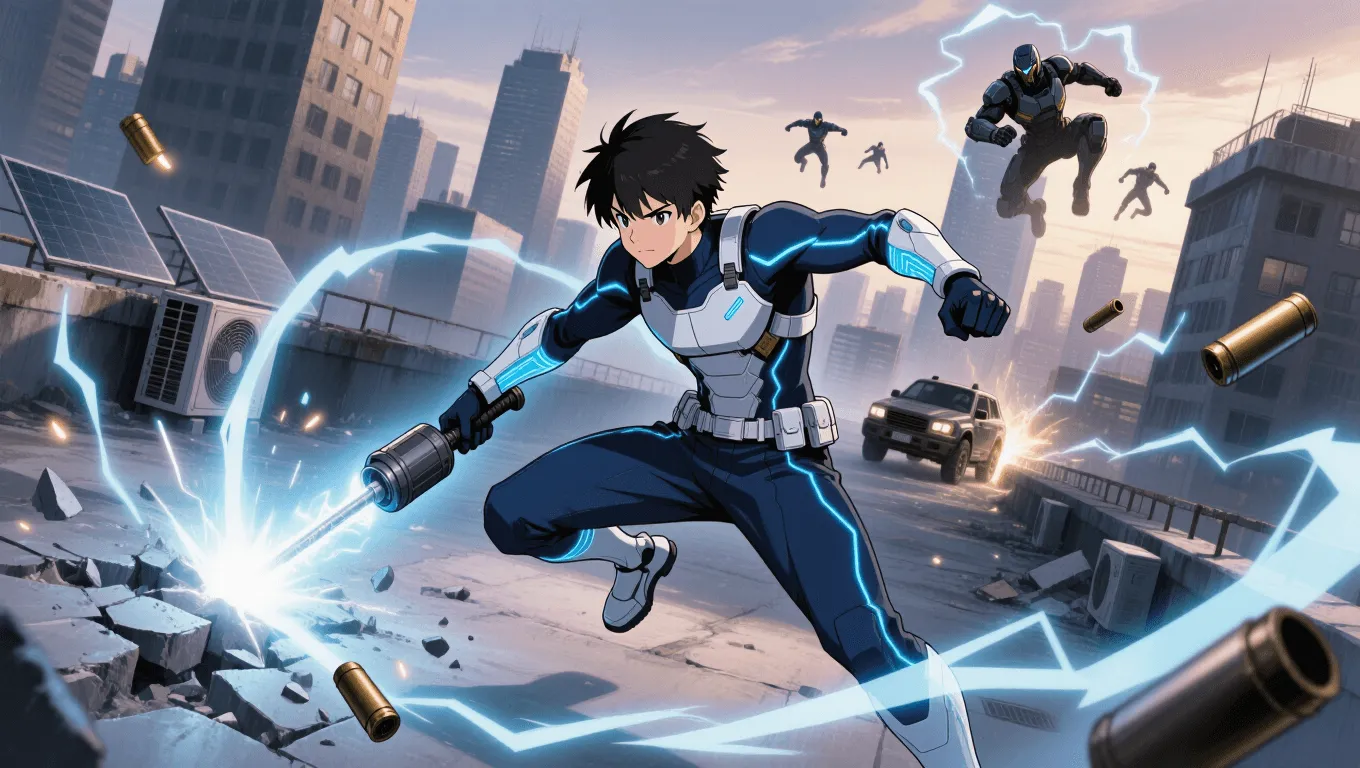
At Level 2, the power reaches a point where the user becomes a serious threat on a city-wide scale:
-
Can maintain high-speed rotation for longer periods and quickly accelerate from a standstill.
-
Drilling attacks can breach reinforced concrete, armored vehicles, and some magical or technological barriers.
-
Spinning flight enables fast traversal between buildings, rooftop combat, and mid-air interception of enemies.
Rotational defense becomes more reliable, allowing the user to shrug off most conventional projectiles and some energy blasts. Their spinning impacts now carry enough force to rip up pavement, crack structures, and create shockwaves.
Level 3 🌃 – Supersonic Vortex
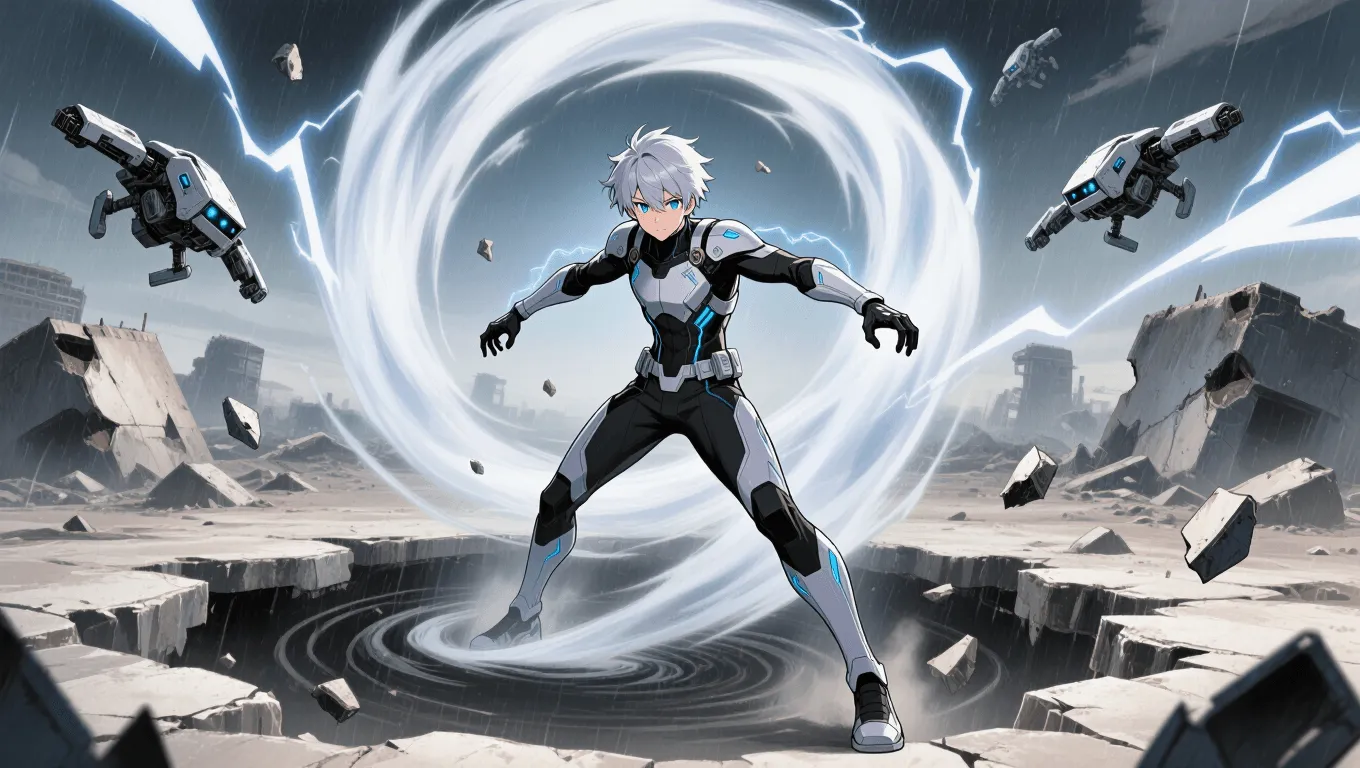
At Level 3, Accelerated Rotation becomes a near-catastrophic power:
-
The user can spin at supersonic or near-supersonic speeds, generating tornado-like winds around themselves.
-
Drilling charges can punch through bunkers, thick energy shields, and extremely durable armor.
-
Flight becomes fast enough to rival many pure-speed or flight-based superpowers.
The defensive spin at this level can create a semi-stable vortex that diverts or disrupts large-scale attacks. However, the destructive potential is so high that collateral damage is almost guaranteed if the user isn’t extremely disciplined.
Limitations of using the Accelerated Rotation
Despite its impressive versatility, Accelerated Rotation comes with notable limitations:
-
Physical strain: Spinning at extreme speeds puts massive stress on the body, especially the inner ear, joints, and muscles. Prolonged use risks nausea, loss of balance, or even unconsciousness.
-
Control issues: Fine control is difficult at high speeds. A slight mistake in trajectory could send the user crashing into allies, critical structures, or hazards.
-
Environmental dependency: Slippery surfaces, uneven terrain, or confined spaces can greatly reduce effectiveness. Some environments simply don’t allow a safe spin-up.
-
Vulnerable start-up and cooldown: The user may need a moment to build momentum and a moment to slow down safely. Both windows can be exploited by clever enemies.
-
Noise and visibility: Spinning at high speed often generates loud sounds and a visible blur or vortex, making stealth nearly impossible.
For players or writers generating new heroes in a setting, these constraints help keep the power balanced alongside other abilities, especially if chosen randomly through tools like a random superpower generator.
Weakness against what other superpowers
Certain power types naturally counter or blunt Accelerated Rotation:
-
Gravity Manipulation: Increased gravity can pin the user down, preventing spin or making it too costly in terms of stamina.
-
Friction or Inertia Control: Powers that dampen momentum, increase drag, or “lock” objects in place can stop a rotating user cold.
-
Telekinesis and Force Restraints: Invisible restraints that hold limbs or the torso can prevent spinning or amplify the risk of self-injury.
-
Power Negation or Erasure: Temporarily nullifying the power removes the user’s momentum advantage, often leaving them vulnerable mid-charge.
-
Time Dilation or Time Stop: Manipulating time can freeze the user in mid-spin or slow them enough for precise counterattacks.
-
Elastic or Absorptive Bodies: Enemies with rubber-like or energy-absorbing forms can negate a drilling charge, harmlessly dispersing the kinetic energy.
Strategically, foes who stay at long range, manipulate terrain, or refuse to cluster together will have a better chance of surviving and outmaneuvering an Accelerated Rotation user.
Synergistic Power Combos
Accelerated Rotation becomes even more dangerous when combined with complementary powers:
-
Elemental Infusion (Fire, Electricity, Wind): Spinning while wreathed in flame or lightning turns the user into a fiery or electrified drill, increasing damage and adding burning or shocking effects.
-
Durability or Armor Enhancement: Reinforced bones, enhanced durability, or powered armor allow the user to survive extreme impacts and push their spin to higher speeds without self-harm.
-
Earth or Metal Manipulation: Combining drilling spins with control over stone or metal creates instant tunnels, traps, and devastating earth-boring attacks.
-
Size Changing: Growing larger increases mass and impact force; shrinking allows needle-like precision strikes. Both scale well with rotational velocity.
-
Precognition or Enhanced Reflexes: Seeing into the immediate future or processing information quickly makes mid-spin maneuvering far safer and more precise.
-
Energy Projection: Spinning beams or streams of energy can create spiraling attacks, expanding cones, or vortex shots that cover wide areas.
These combinations allow Accelerated Rotation to evolve from a straightforward physical power into a complex, multi-role toolkit capable of assault, defense, mobility, and battlefield control.
Known Users
While Accelerated Rotation appears in many fictional settings under different names (drill spin, tornado mode, spiral charge), several archetypal characters stand out:
-
A street-level vigilante who uses spinning tackles and wall-drilling to ambush criminals from beneath city streets.
-
A high-tech hero whose armor transforms into a spinning drill form for breaching bunkers and deflecting artillery.
-
A flying “human tornado” who spins so fast they generate localized storms, using whirlwind flight and drilling dives to disrupt aerial threats.
In established comics, a good reference point is Whirlwind, a character known for using high-speed spinning to attack and evade foes. While not always identical to Accelerated Rotation as defined here, such characters illustrate how a rotation-based power can be adapted into different fighting styles and narrative roles.
These examples help ground Accelerated Rotation as a recognizable, flexible superpower that fits neatly into any setting that explores motion, momentum, and the creative use of spin.