
Elasticity

Elasticity Video Demo 🎬
Table of Contents
Elasticity is a superpower that lets a person stretch, twist, compress, and reshape their body to extreme degrees without tearing, breaking, or losing function. With Elasticity, limbs can extend like rubber, the torso can coil or flatten, and impacts can be absorbed by bending and rebounding rather than cracking bones. In superpowered worlds, Elasticity is prized because it turns the body into a living tool: flexible defense, unpredictable offense, and versatile mobility all in one. Readers exploring abilities like this can browse the Superpower Wiki or roll something unexpected on the random superpower generator.
What Is Elasticity
Elasticity is the ability to radically increase the body’s flexibility and deformability while maintaining strength, control, and recovery to a normal shape. It often resembles a rubber body, malleable physiology, or extreme contortion, but the key difference is performance under stress: an elastic user can stretch far beyond human limits, snap back safely, and keep full coordination.
Depending on the setting, Elasticity may be biological (cells and tissues behave like advanced elastomers), energetic (a force field maintains cohesion), or reality-warp adjacent (the body’s “rules” are rewritten). Regardless of the source, the practical outcome is similar: extended reach, shape-changing defense, and a high tolerance for blunt trauma.
Core abilities of Elasticity
Elasticity is more than “stretchy arms.” At higher mastery, it becomes a complete body-management toolkit.
-
Limb extension and reach control: Arms, legs, neck, and fingers can elongate for long-range strikes, grapples, rescues, or weapon disarms.
-
Full-body deformation: The user can flatten, widen, coil, twist, knot, or squeeze through gaps that would be impossible for a rigid skeleton.
-
Compression and expansion: The body can compact to reduce profile, slip restraints, or store kinetic energy for spring-like jumps.
-
Impact absorption and rebound: Blunt force can be dispersed by deforming, reducing internal damage and allowing bounce-back counterattacks.
-
Elastic grappling: The user can wrap opponents, bind limbs, create living restraints, or form an improvised net.
-
Shape adaptation: Without becoming a different person, an elastic body can create functional shapes such as shields, hammers, wedges, or cushions.
-
Momentum redirection: By stretching and anchoring, the user can redirect their own velocity or an enemy’s force like a living slingshot.
-
Enhanced contortion and evasion: The user can “flow” around strikes, bullets (in some depictions), and environmental hazards by bending out of the attack line.
Common secondary traits include high pain tolerance, reinforced skin, and unusual proprioception (the sense of where every body part is in space), because controlling a 10-meter arm requires a brain that can map it.
Application / Tactical Advantages in Combat
Elasticity shines in combat because it breaks assumptions about distance, angles, and what counts as “a safe position.” It can be used to control space, protect allies, and end fights without lethal force.
Key combat uses include:
-
Range dominance: Elastic users can strike from unexpected distances, punish evasive opponents, and attack around cover.
-
Grapple supremacy: Stretch-based wraps, holds, and joint control can neutralize stronger enemies by limiting movement.
-
Crowd control: A single user can trip lines of foes, create barriers with their own body, or yank weapons away.
-
Defense without armor: Deformation can reduce blunt damage, cushion falls, and mitigate shockwaves.
-
Mobility tricks: Swinging, pole-vaulting, slingshot launches, and rapid cornering become natural movement options.
-
Unpredictable angles: Attacks can arc, whip, or snap from blind spots that normal biomechanics can’t reach.
Level: Level 1 🏙️
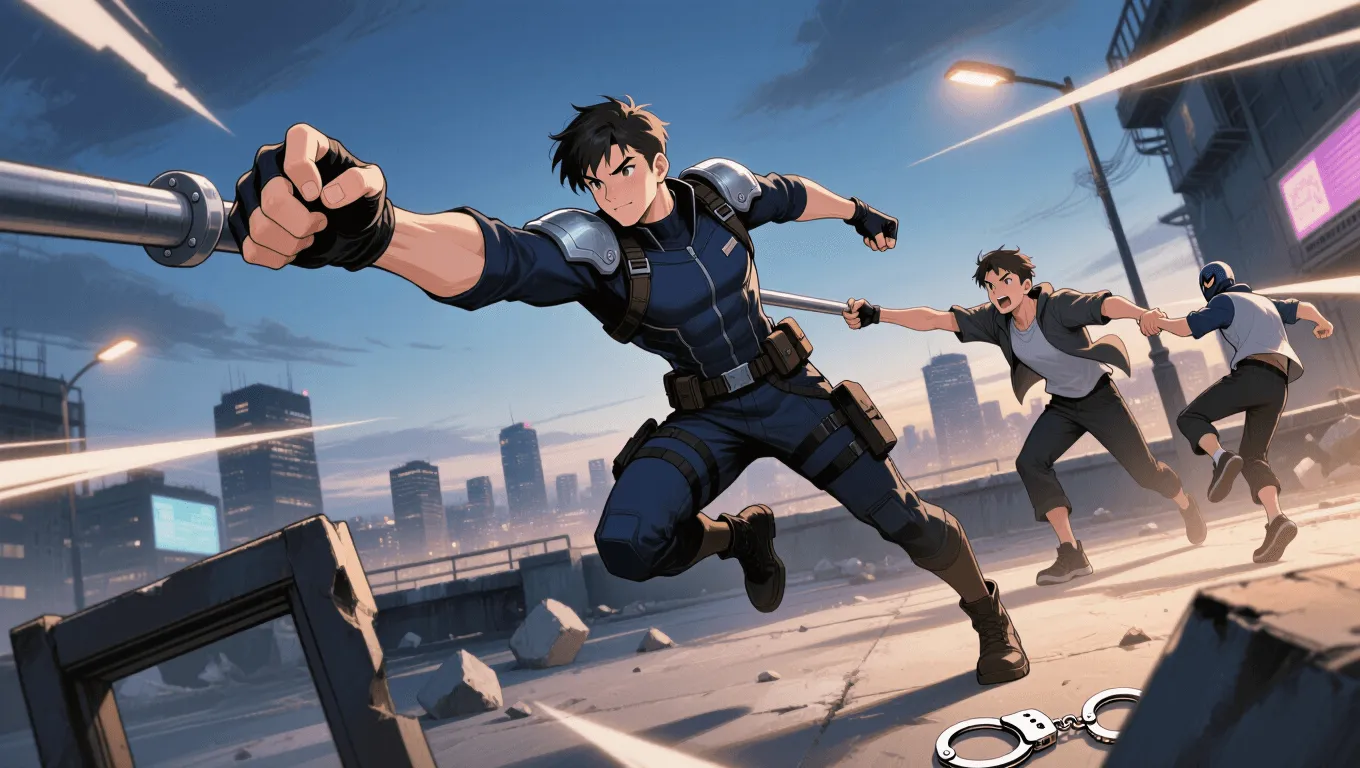
At Level 1, Elasticity is noticeable but not world-breaking.
-
Short-range stretching: Limbs extend a few meters, useful for grabbing objects, landing surprise punches, or pulling an ally to safety.
-
Basic compression: The user can slip cuffs, squeeze through partially open doors, or reduce injury from falls.
-
Beginner rebound: Blunt hits hurt less, but sharp damage still matters. The user may bounce off impacts unintentionally.
-
Simple grapples: Wrapping an opponent is possible, but maintaining control against strong resistance is difficult.
Tactically, Level 1 Elasticity favors ambush and utility: disarms, trip attacks, quick rescues, and evasive defense.
Level: Level 2 🌇
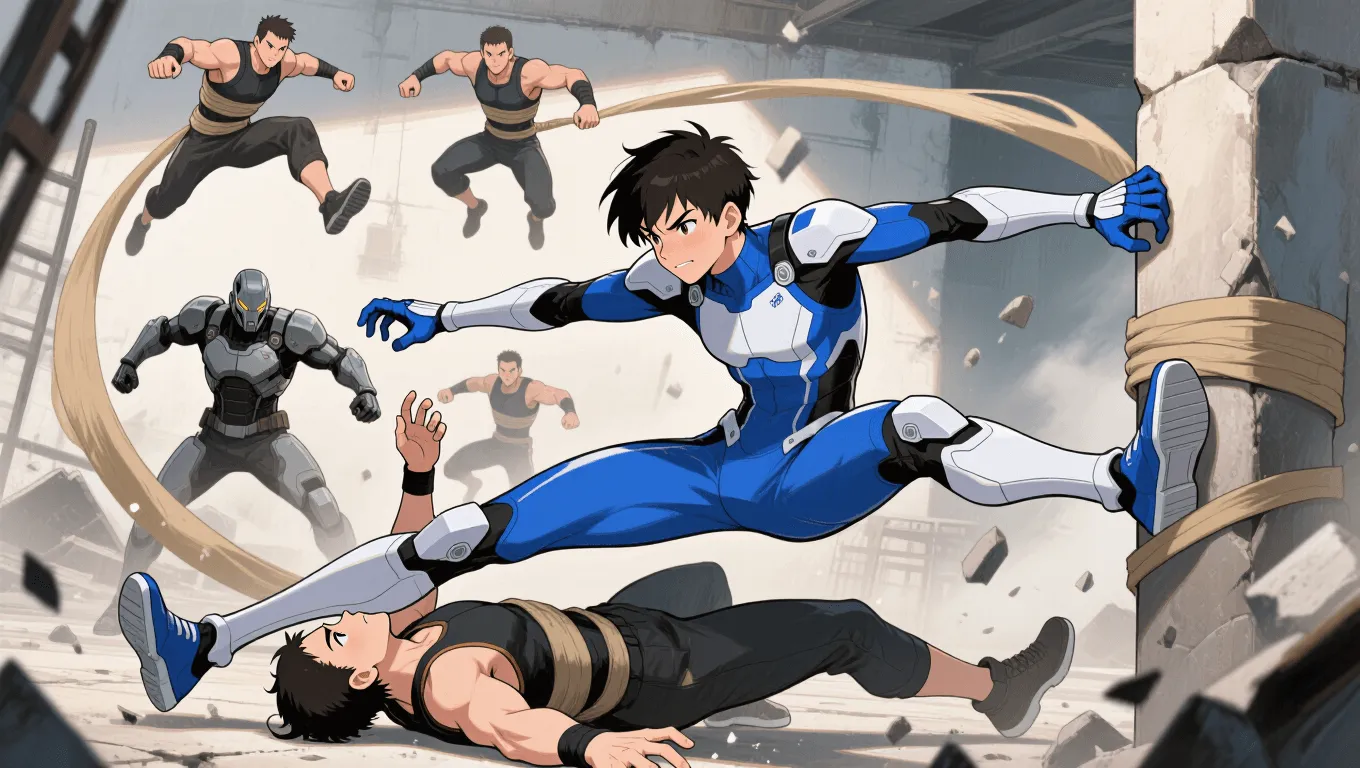
At Level 2, the power becomes a genuine combat style rather than a trick.
-
Controlled long-range striking: Precision whip strikes, multi-angle punches, and mid-range grabs become reliable.
-
Advanced body shaping: The user can form shields, braces, battering-ram shapes, or cushioning platforms for allies.
-
Strong restraint techniques: Full-body wraps and elastic binds can immobilize a single target or restrain multiple foes briefly.
-
Kinetic storage: The user can compress like a spring and release for explosive leaps, tackles, or evasive bursts.
-
Environmental weaponization: Using poles, walls, and anchors, the user can slingshot objects or swing through combat zones.
Tactically, Level 2 Elasticity controls tempo: it interrupts enemy setups, punishes ranged attackers by closing distance, and protects teammates with reactive body-blocking.
Level: Level 3 🌃
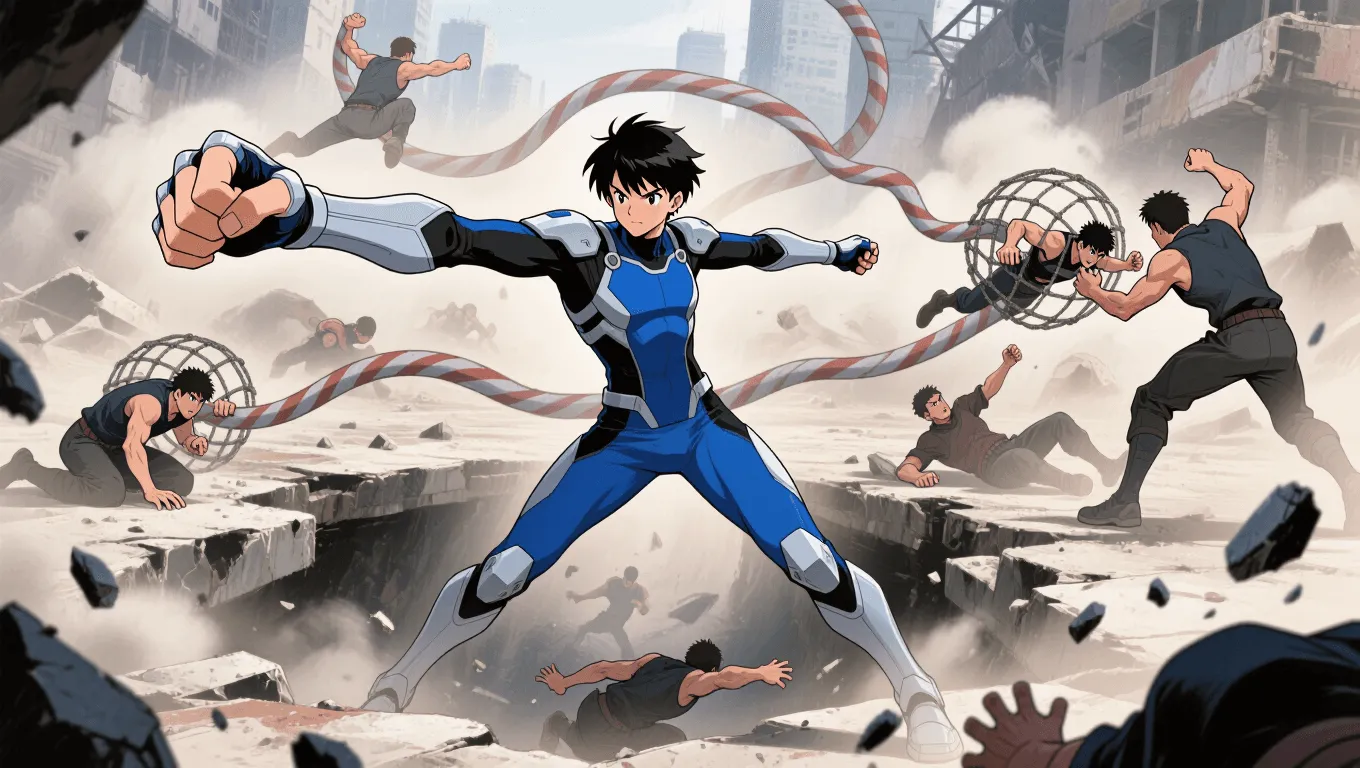
At Level 3, Elasticity becomes battlefield-level control with near-superhuman survivability and creativity.
-
Extreme extension and multitasking: Arms and body sections can operate at different angles simultaneously, enabling multi-target control.
-
High-speed elasticity: Snap strikes and recoil movement become fast enough to overwhelm typical reaction times.
-
Near-total contortion: The user can thread through tiny gaps, evade in close quarters, and escape most restraints.
-
Shockwave mitigation: Deformation disperses concussive energy effectively; falling debris and blunt blasts become less threatening.
-
Elastic constructs via posture: Without creating separate matter, the user can imitate tools: living bridges, net traps, giant fists, dome shields, or a rotating “cage” around enemies.
-
Grapple lockdown: Anchored wraps can pin super-strong targets by leveraging friction, angles, and body mass distribution rather than raw strength.
At this tier, Elasticity is a control power: it wins by positioning, immobilizing, and protecting, not just by damage output.
Limitations of using the Elasticity
Elasticity is powerful, but it is rarely “free.” Most versions include constraints that prevent it from becoming invincible.
-
Sharp-force vulnerability: Knives, claws, piercing projectiles, and cutting energy often bypass the benefits of deformation. Stretchy tissue can still be sliced.
-
Overextension strain: Stretching too far can cause loss of control, delayed recoil, numbness, or temporary “dead zones” in extended limbs.
-
Temperature sensitivity: Extreme cold can stiffen an elastic body, reducing flexibility. Extreme heat can soften structure, making control sloppy.
-
Adhesion and friction problems: Sticky substances, tar, glue, webbing, or hardening foam can trap an elastic user more effectively than a rigid one.
-
Internal stability: Even if the exterior stretches, organs must remain functional. High-G slingshots or rapid whiplash can cause dizziness or disorientation.
-
Pain and proprioception overload: Managing a body extended across multiple directions can overwhelm concentration, especially under sensory attacks.
-
Energy and stamina cost: In many settings, holding extreme shapes drains stamina. Long fights can reduce maximum stretch and rebound strength.
-
Form recovery time: After extreme deformation, returning to normal may require a short reset window, leaving the user briefly vulnerable.
Practical counters often involve forcing the elastic user into situations where stretching is a disadvantage: narrow spaces with sharp edges, extreme temperatures, adhesive hazards, or multi-directional attacks that exceed their ability to track.
Weakness against what other superpowers
Elasticity tends to struggle against powers that ignore or exploit deformation.
-
Blade generation and weapon summoning: Cutting attacks can injure stretched limbs easily, especially if the user is extended and can’t retract fast.
-
Acid generation and corrosion: Chemical damage can weaken elastic tissue and reduce recoil control.
-
Heat manipulation and fire: High heat can degrade structural integrity, cause painful burns, and force the user to retract.
-
Cryokinesis and freezing: Cold can stiffen the body, limiting stretch range and making the user brittle in some depictions.
-
Adhesive secretion and binding powers: Glue, webbing, slime, or hardening foam can lock joints and prevent recoil.
-
Electricity manipulation: If the user’s body conducts well, shocks can disrupt muscle control and cause involuntary contractions.
-
Density manipulation or immutability: Opponents who become too heavy or unmovable can nullify elastic grapples and anchors.
-
Telekinesis: A strong telekinetic can pin stretched limbs, suspend the user mid-air, or counter slingshot momentum.
-
Sound-based attacks: Sonic waves can rattle internal organs and disorient the user even if the body “bends” the impact.
-
Molecular disruption: Powers that weaken bonds or unravel matter can bypass the durability advantage entirely.
In matchups, Elasticity performs best when it can stay mobile, keep angles unpredictable, and avoid committing to long extensions that invite counterattacks.
Synergistic Power Combos
Elasticity becomes dramatically stronger when paired with abilities that patch its main weaknesses or enhance its best traits.
-
Regeneration or Healing Factor: Mitigates cuts, tears, and internal strain, allowing riskier tactics and longer engagements.
-
Invulnerability or durability boosts: Turns elastic defense into near-absolute protection, enabling body-shielding and aggressive grapples.
-
Super strength: Makes elastic strikes devastating and elastic restraints nearly inescapable.
-
Enhanced reflexes or precognition: Helps manage multi-angle limb control and avoid sharp counters.
-
Adhesion (wallcrawling) or friction control: Improves anchoring for slingshots, swing mobility, and grapple lockdown.
-
Density control (self): Switching between light (for speed) and heavy (for grapples) makes elasticity more tactical.
-
Energy projection: Lets the user deliver ranged damage through extended limbs or channel blasts around cover.
-
Illusions or invisibility: Elastic attacks become harder to predict when the enemy can’t track the body’s true position.
-
Force fields: Creates a protective “skin” that reduces cutting vulnerability and stabilizes extreme shapes.
-
Elemental resistance: Fire resistance and cold resistance neutralize major counters and keep the body responsive.
Team synergy is also strong: an elastic user pairs well with snipers (pulling targets into sightlines), tanks (providing mobile cover), and controllers (locking enemies while allies finish the fight).
Known Users
Elastic body powers appear across comics, animation, and manga, often as a signature fighting style or a creative problem-solving tool.
-
Plastic Man (DC Comics) – a classic example of a full-body elastic hero with extreme shape control.
-
Mister Fantastic (Reed Richards, Marvel Comics) – known for elastic reach, restraint tactics, and inventive defensive shaping.
-
Elastigirl (Helen Parr, The Incredibles) – combines elasticity with acrobatics and rescue-focused combat utility.
-
Monkey D. Luffy (One Piece) – uses rubber-like stretching for high-momentum strikes and creative mobility techniques.
-
Jake the Dog (Adventure Time) – demonstrates versatile shape adaptation and comedic-to-serious combat elasticity.
For more abilities like this, the Superpower Wiki helps compare similar body-based powers, while the random superpower generator is a quick way to discover unexpected combinations.