
Helicopter Propulsion Superpower Guide

Helicopter Propulsion Video Demo 🎬
Table of Contents
- Helicopter Propulsion Video Demo 🎬
- What Is Helicopter Propulsion?
- Core Abilities of Helicopter Propulsion
- Application / Tactical Advantages in Combat
- Level: Level 1 🏙️, Level 2 🌇, Level 3 🌃
- Limitations of Using Helicopter Propulsion
- Weakness Against What Other Superpowers
- Synergistic Power Combos
- Known Users
What Is Helicopter Propulsion?
Helicopter Propulsion is a flight-based superpower that allows a character to fly by spinning limbs or attached devices like rotors. Instead of wings or pure anti-gravity, the user generates lift through rapid rotation, much like a personal helicopter. Arms, legs, tails, hair, mechanical harnesses, or energy constructs can all act as spinning blades that create vertical lift, hover capability, and controlled aerial movement.
This power sits in the family of movement and mobility abilities found in many fantasy and superhero settings. On a spectrum of flight powers, Helicopter Propulsion is more mechanical and directional than simple levitation, but often more flexible than rigid winged flight. It naturally pairs well with other abilities listed in the wider superpower catalog, which can be explored through a full superpower wiki for worldbuilders and game masters.
Characters with this ability can rise straight up, hover in place, dart sideways, or swoop down with precise control. The signature image is an individual spinning like a living rotorcraft, kicking up wind and dust as they lift off the ground.
Core Abilities of Helicopter Propulsion
Vertical takeoff and landing (VTOL)
The most iconic feature of Helicopter Propulsion is vertical takeoff and landing. The user can:
-
Launch straight up from a standing position.
-
Land gently on rooftops, balconies, or small ledges.
-
Hover above obstacles instead of needing a runway or a long glide path.
This makes it ideal in dense cities, forests, or underground spaces where normal flight would be impractical.
Hovering and precise positioning
Rotor-based flight excels at holding position. A character can:
-
Hover at a fixed point to scout, snipe, or guard an area.
-
Maintain a steady altitude just above ground traps, lava, water, or unstable terrain.
-
Make micro-adjustments to avoid projectiles or to stay just out of melee range.
This hovering ability turns Helicopter Propulsion into a powerful tool for surveillance, tactical support, and crowd control.
Agile aerial maneuverability
Unlike straight-line rocket flight, Helicopter Propulsion allows nimble, multi-directional movement:
-
Instant lateral shifts and sharp turns in mid-air.
-
Sudden altitude changes—dropping, then surging upward again.
-
Tight spirals, spins, and strafing runs around enemies.
This agile rotor flight gives the user a three-dimensional battlefield, letting them exploit angles that ground-based opponents simply cannot match.
Wind generation and environmental control
The spinning limbs or devices naturally create powerful downdrafts and gusts:
-
Blowing away smoke, gas, or fog.
-
Knocking light enemies off balance.
-
Disrupting incoming projectiles like arrows or thrown weapons.
-
Stirring up dust or debris to create a makeshift smokescreen.
At higher levels, the user can focus this airflow into directed blasts, using Helicopter Propulsion as a crude form of wind manipulation.
Load-bearing and transport
Strong users can carry:
-
A second person for rescue or infiltration.
-
Equipment such as heavy weapons, supplies, or medical kits.
-
Small vehicles or containers, acting like a living cargo drone.
How much weight they can support depends on mastery level and physical conditioning, but the potential for airlift operations is one of the power’s biggest narrative and tactical strengths.
Application / Tactical Advantages in Combat
In combat, Helicopter Propulsion is a mobility power first, with several key advantages:
-
Hit-and-run attacks: The user can dive in, strike, and pull back out of melee range before enemies can counter.
-
High-ground domination: Being able to hover gives excellent firing lines for ranged attacks, whether mundane or energy-based.
-
Rapid redeployment: The user can cross rooftops, ravines, or battlefield zones far faster than most ground troops.
-
Rescue and extraction: They can pluck allies out of danger zones, collapsing buildings, or hazardous terrain—perfect for heroic rescues.
-
Zone denial: Downdrafts and rotor wash can make it hard for enemies to stand, aim, or approach certain positions.
In roleplaying games or superhero fiction, this power also shines in exploration scenes, stealthy roof-hopping, and dramatic cinematic entrances—descending like a whirling silhouette from the sky.
For creators looking to combine Helicopter Propulsion with other abilities, it can be helpful to browse or randomly discover related mobility or wind-themed powers with a random superpower generator.
Level: Level 1 🏙️, Level 2 🌇, Level 3 🌃
Level 1 🏙️ – Urban Hover
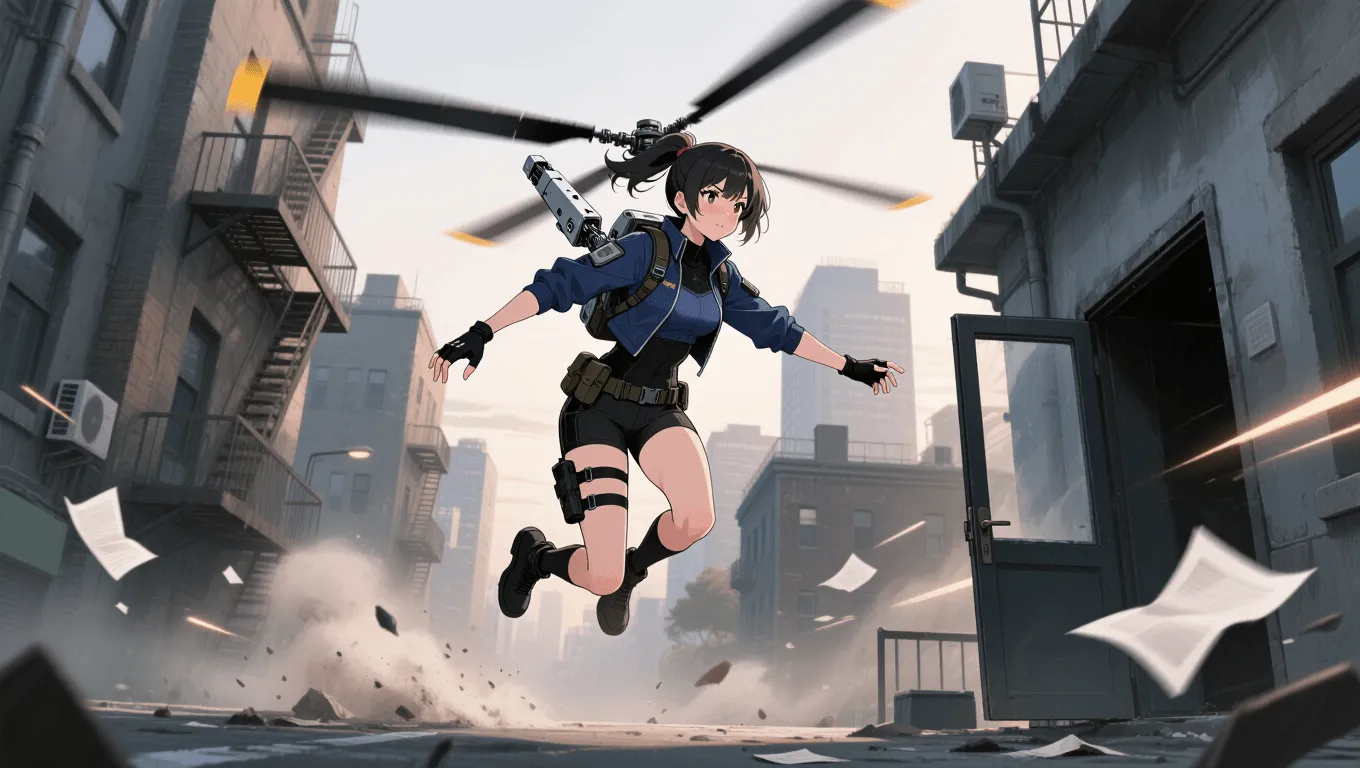
At Level 1, Helicopter Propulsion is unstable but usable:
-
The user can lift themselves a few stories high—ideal for street-level rooftops and balconies.
-
Hover time is limited; sustained flight quickly causes fatigue or dizziness.
-
Takeoff and landing are a bit rough, with messy downdrafts and hard landings.
-
Direction changes are slow, and sudden stops may send the user spinning uncontrollably.
In this stage, the power is best for short bursts: jumping gaps between buildings, making quick escapes, or gaining vantage points, rather than long-distance travel.
Level 2 🌇 – City Skyrunner
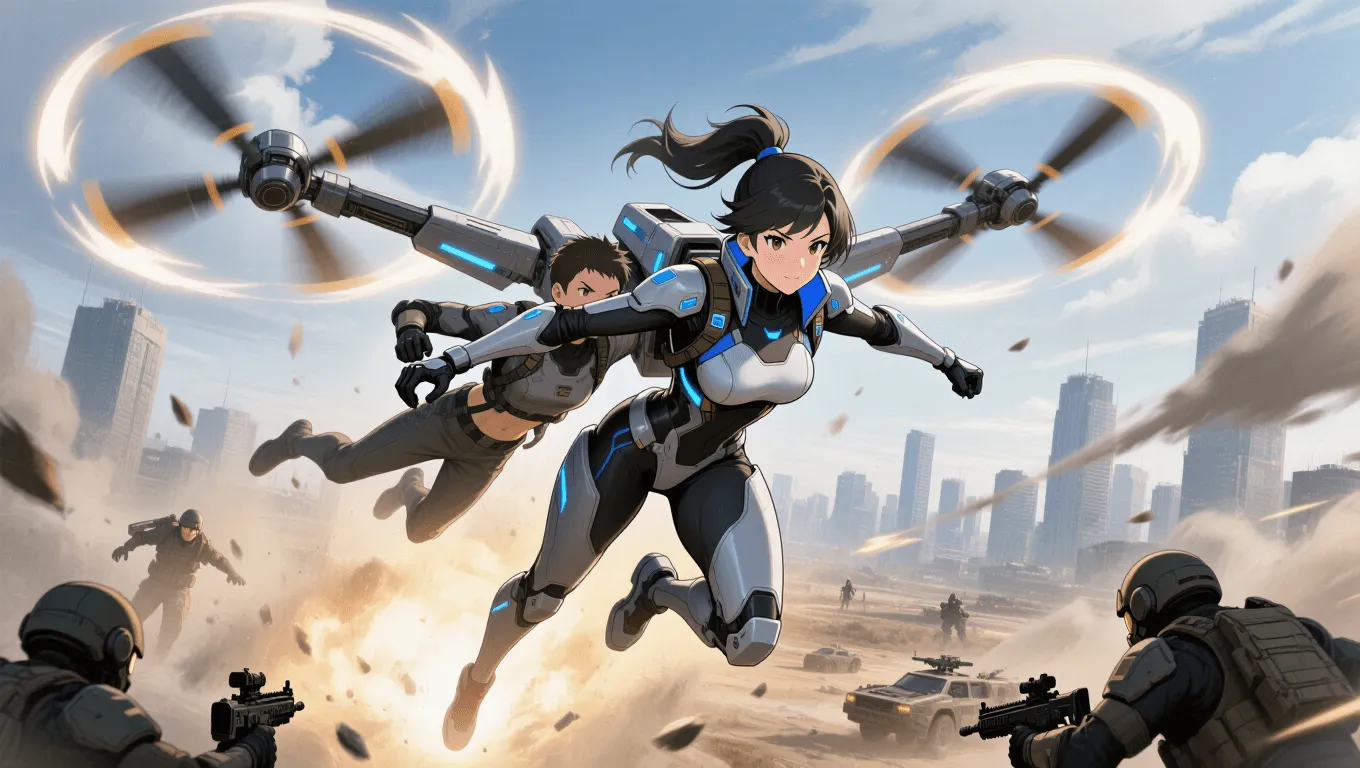
At Level 2, the character shows clear mastery:
-
Flight becomes stable enough for extended patrols across a city or battlefield.
-
The user can maintain a steady hover, even in moderate wind.
-
Speed improves, allowing rapid flanking maneuvers and large-scale scouting.
-
Rotor wash can be intentionally used to knock enemies over, disperse gas clouds, or control crowds.
-
Carrying a single passenger or moderate load becomes possible, though it still reduces agility.
Here Helicopter Propulsion shifts from a situational trick to a core part of the character’s combat style and team role.
Level 3 🌃 – Aerial Dynamo
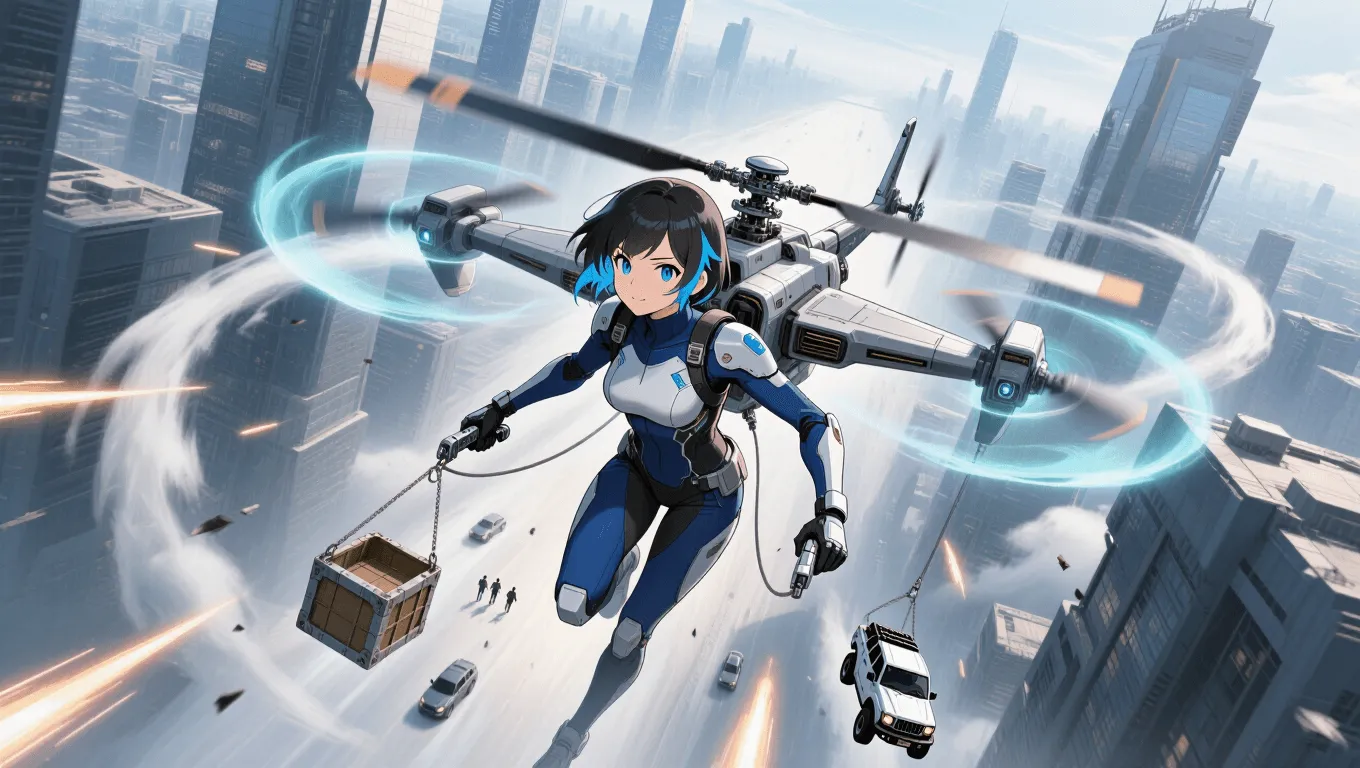
At Level 3, Helicopter Propulsion becomes a signature, high-tier mobility power:
-
The user can fly long distances at high speed and with superb control.
-
They can perform advanced maneuvers: hovering inches from a target, weaving through tight indoor spaces, or dodging multiple projectiles.
-
Rotor speed and angle can be fine-tuned, creating precise wind blasts to deflect attacks or shape the battlefield.
-
They may be able to carry multiple passengers, light vehicles, or heavy equipment, acting like a personal airborne transport.
-
Some advanced users can partially mute the sound of their rotors, enabling stealthy approaches despite the inherently noisy nature of the power.
At this level, the character can dominate vertical space, outmaneuver most flyers relying on more rigid methods of flight.
Limitations of Using Helicopter Propulsion
No superpower is without drawbacks. Helicopter Propulsion has several key limitations:
-
Energy and stamina: Spinning limbs or heavy rotors is physically demanding. Long use can cause muscle strain, joint damage, or exhaustion.
-
Noise and visibility: Rotor motion and airflow are loud and obvious, making stealth difficult for most users.
-
Environmental dependence: Strong storms, extreme turbulence, or thin atmosphere can severely reduce lift and control.
-
Confined spaces: Tight indoor areas and low ceilings restrict spinning limbs and rotor arcs, increasing the risk of collisions.
-
Vulnerability while airborne: If the user is stunned, immobilized, or loses concentration mid-flight, they may fall from dangerous heights.
-
Mechanical failure (for device users): Those who rely on mechanical rotors can suffer gear jams, damage from enemy attacks, or sabotage.
These weaknesses help keep Helicopter Propulsion from overshadowing every other movement power and give opponents realistic ways to counter it.
Weakness Against What Other Superpowers
Helicopter Propulsion can be directly or indirectly countered by several types of abilities:
-
Wind and weather manipulation: Sudden crosswinds, microbursts, or vacuum zones can destabilize rotors and send the user crashing.
-
Gravity control: Increasing gravity around the user makes it harder or impossible to generate enough lift.
-
Binding and restraint powers: Webbing, vines, chains, or telekinetic holds that immobilize limbs immediately shut down rotor-based flight.
-
Power negation: Any ability that cancels or dampens superpowers—or the energy source driving mechanical rotors—can drop the user from the sky.
-
Projectile redirection or sniping: While airborne, the user can be an exposed target for precision shooters or homing attacks.
-
Technopathy and electromagnetism (for tech-based rotors): Devices can be hacked, jammed, or fried, turning the propulsive apparatus into dead weight.
These interactions make Helicopter Propulsion an interesting tactical element in a setting, rewarding clever counters instead of simple brute force.
Synergistic Power Combos
Helicopter Propulsion pairs extremely well with other abilities. Some strong combinations include:
-
Durability or force fields: Enhanced durability, armor, or personal shields allow high-speed aerial ramming attacks and reduce the risk of injury from falls.
-
Ranged energy or projectile powers: Firing beams, arrows, or bullets from hovering positions creates a mobile “gunship” role, raining attacks from above.
-
Enhanced senses or targeting: Super sight, radar-like perception, or danger sense makes aerial scouting and precision strikes far more effective.
-
Invisibility or light-bending: If the user can conceal themselves, the usual noise and visual tell of the rotors is partly mitigated, enabling ambushes from unexpected angles.
-
Elemental control (air or fire): Air manipulation can stabilize or augment rotor lift, while fire or plasma around the spinning limbs turns them into blazing cutting tools.
-
Teleportation or short-range warps: Combining teleportation with Helicopter Propulsion creates unpredictable movement, making it almost impossible to predict the user’s next position.
Creators can mix and match combos using the broader list of abilities available in the superpower wiki, designing aerial specialists, rescue heroes, or terrifying sky raiders.
Known Users
In many original settings, Helicopter Propulsion appears in a variety of characters:
-
Tech-based heroes and villains who wear rotor rigs, drone harnesses, or mechanical backpacks that spin like compact helicopter assemblies.
-
Biologically altered individuals whose arms, legs, or hair can flatten and spin like rotor blades, sometimes accompanied by reinforced bones or joints.
-
Energy manipulators who manifest glowing, spinning discs of force around their limbs, mimicking helicopter rotors without needing physical blades.
While mainstream comics rarely feature characters with pure Helicopter Propulsion, similar concepts can be seen in airborne heroes and androids who control air currents or spin to achieve flight. For example, the DC character Red Tornado uses powerful whirlwinds and vortices to fly and manipulate the battlefield, showcasing how rotation-based movement and wind control can be dramatized in visual media.
Game masters, writers, and players can easily adapt this superpower to fit their own universes—whether as a quirky gadgeteering hero, an agile rooftop scout, or a storm-like aerial menace whose spinning silhouette is the last thing enemies see from the ground below.