
Nano Manipulation: Commanding Nanomachines for Repair, Attack, and Reshaping

Nano Manipulation Video Demo 🎬
Table of Contents
Nano Manipulation is the ability to command nanomachines—often called nanites or nanobots—to perform complex tasks at microscopic scales. A skilled user can direct these tiny machines like a programmable swarm, turning them into armor, tools, medical repair systems, or precision weapons. Because Nano Manipulation blends nanotechnology control with fast, adaptable decision-making, it can feel like having an entire factory, hospital, and weapons lab living inside a single command signal. For readers who enjoy exploring high-tech powers, the Superpower Wiki has more abilities to compare, and the random superpower generator is a quick way to discover new power ideas.
What Is Nano Manipulation
Nano Manipulation is the controlled use of nanomachines to alter matter, bodies, or environments. In practical terms, nanites can be instructed to assemble, disassemble, reinforce, repair, or reshape materials by moving molecules and microscopic components into new configurations. Some versions focus on internal nanites (living in the bloodstream or stored in a suit), while others rely on external swarms released into the air like metallic dust.
Unlike simple gadgetry, Nano Manipulation behaves like programmable matter: the user is not merely holding a tool—they are directing a flexible system that can become many tools. When the command is precise, it enables everything from instant patchwork healing to on-the-fly weapon crafting.
Core abilities of Nano Manipulation
Nano Manipulation can express itself in many ways, but most users fall into a few “core” functions.
-
Nanite swarm control: Directing a cloud of nanobots as if it were a single organism—splitting, regrouping, or forming shapes on command.
-
Micro-repair and regeneration support: Stitching tissue, sealing wounds, repairing bones, filtering toxins, or stabilizing organs (often described as nanotech healing).
-
Molecular reconstruction and reshaping: Rebuilding damaged objects, reshaping surfaces, or converting raw matter into temporary structures (within limits).
-
Adaptive armor and weaponization: Forming self-repairing armor, blades, shields, spikes, grapples, or projectile systems that can reconfigure instantly.
-
Infiltration and sabotage: Slipping nanites through cracks, vents, or porous materials to jam mechanisms, weaken joints, blind sensors, or “lock” moving parts.
-
Sensor web and reconnaissance: Using distributed nanites as tiny cameras/mics/chemical sniffers to map rooms, detect heat, identify materials, or track targets.
-
Nano-construct fabrication: Producing hard-light-like “solids” made of packed machines—platforms, restraints, ladders, barricades, and decoys.
-
Self-cleaning and environmental adaptation: Filtering air, neutralizing contaminants, resisting radiation exposure, and adjusting surface texture for traction or stealth.
Application / Tactical Advantages in Combat
In combat, Nano Manipulation is dangerous because it compresses multiple roles into one: defender, striker, medic, engineer, and controller. The power excels at changing the terms of the fight—turning cover into a trap, making injuries temporary, and forcing opponents to waste time dealing with swarms they can’t easily grab or punch.
Typical tactical advantages include:
-
Instant loadout switching: A sword becomes a shield, the shield becomes armor plating, the plating becomes a grappling line.
-
Force multiplication: A single user can pressure multiple angles—binding one enemy while blinding another and repairing themselves simultaneously.
-
Precision disruption: Nanites can target buckles, latches, optics, triggers, joints, and circuitry—small failures that create huge openings.
-
Self-repairing endurance: Armor can “heal” mid-fight, and minor injuries can be patched fast enough to keep moving.
-
Terrain hacking: Floors gain friction, walls become climbable, doors jam, vents clog, or debris reassembles into barriers.
Level: Level 1 🏙️
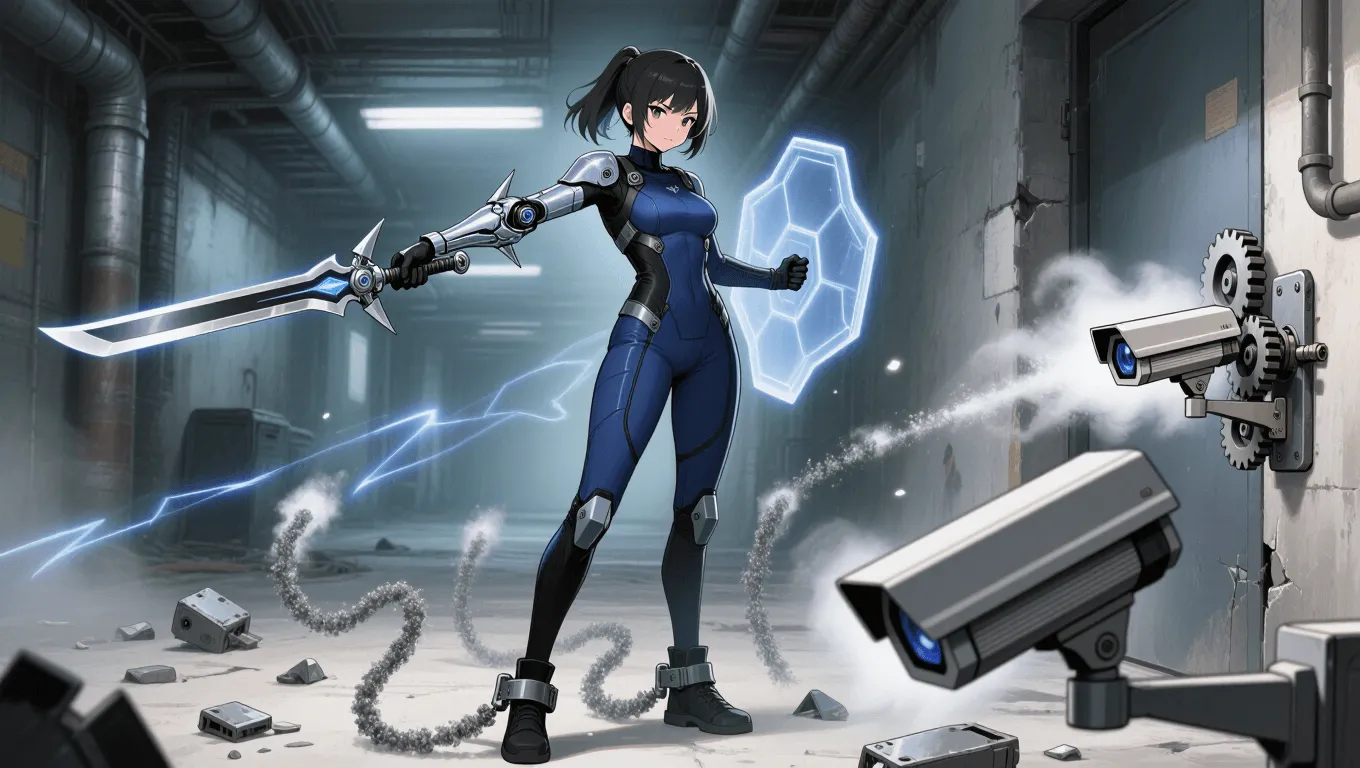
At Level 1, Nano Manipulation is practical and focused, usually limited by range, processing complexity, and nanite supply.
-
Forms simple armor plating and basic weapons (blades, spikes, batons).
-
Repairs small breaks and seals minor wounds; reduces bleeding and stabilizes shock.
-
Creates short-lived constructs like handholds, cuffs, or small shields.
-
Performs basic sabotage: jamming a lock, gumming a hinge, fogging a lens.
-
Uses nanites for limited scouting within a room or along a corridor.
Level 1 users win through versatility, but they still need time and concentration for complex shapes. They also struggle against opponents who can overwhelm the swarm faster than it can regroup.
Level: Level 2 🌇
At Level 2, the user treats nanites like a full combat ecosystem—defense, offense, and support running together.

-
Maintains a self-repairing armor shell that reconfigures based on incoming threats.
-
Produces multi-part weapons (ranged emitters, segmented whips, drilling spikes, shock nets).
-
Executes targeted “system kills” against gear: severing cables, shorting components, gumming motors.
-
Performs emergency medical repair: splinting fractures, closing deep cuts, detox support.
-
Establishes a wider sensor net, tracking movement and identifying weaknesses in materials.
Level 2 users become hard to pin down because they can switch tactics instantly and sustain pressure without relying on a single weapon style.
Level: Level 3 🌃
At Level 3, Nano Manipulation approaches high-end programmable matter control, with rapid reconfiguration and advanced reconstruction.

-
Rapidly reshapes large volumes of nanites into complex constructs (barriers, cages, platforms, multi-limb tools).
-
Performs advanced repairs on vehicles, heavy armor, or structural damage—often in seconds to minutes depending on scale.
-
Executes precision neutralization: disabling a weapon mid-swing, sealing vents, immobilizing limbs with adhesive micro-lattices.
-
Deploys distributed swarms for wide-area denial: choking visibility, clogging mechanical joints, and forcing enemies into predictable routes.
-
Creates layered defense: inner medical nanites, mid-layer armor, outer counter-swarm “screen” that intercepts projectiles or drones.
At this tier, the primary limiter is not imagination—it’s resource management, heat/energy demands, and whether the user can maintain clean command signals under stress.
Limitations of using the Nano Manipulation
Despite its flexibility, Nano Manipulation is not infinite magic. Strong versions still depend on real constraints.
-
Nanite supply and mass: Nanites need matter. If the user runs out of machines (or raw feedstock), their constructs shrink, weaken, or fail.
-
Energy and heat: High-speed reshaping, drilling, or continuous defense can generate heat and drain power reserves quickly.
-
Command complexity: The more detailed the task, the heavier the cognitive or computational load. Multitasking can reduce precision.
-
Range and signal integrity: Many users have a control radius. Interference, shielding, distance, or underground environments can cut effectiveness.
-
Vulnerability during “rebuild”: Transformations often require fractions of a second where armor thins, constructs reconfigure, or swarms relocate.
-
Contamination and clogging: Sticky chemicals, dense particulates, or corrosive environments can foul nanites and degrade performance.
-
Ethical and safety risks: Unchecked replication is a classic hazard in fiction; responsible Nano Manipulation typically includes hard limits to prevent runaway behavior.
Weakness against what other superpowers
Nano Manipulation has clear counters, especially from powers that disrupt control signals, destroy tiny mechanisms, or outpace reconfiguration.
-
Electromagnetic Manipulation: Strong electromagnetic fields, EMP-like bursts, or targeted interference can scramble coordination and disable delicate machines.
-
Technopathy: If a technopath can “speak the language” of the nanites, hacking, hijacking, or command spoofing becomes a major threat.
-
Sonic Manipulation: High-intensity vibration can shake apart dense nanite constructs, disrupt swarm cohesion, and reduce precision in close quarters.
-
Acid Generation: Corrosives can melt or pit nanite shells and destroy micro-actuators faster than they can self-repair.
-
Extreme Heat or Cold powers: Thermal extremes can warp components, drain batteries, freeze moving parts, or force the swarm into inefficient modes.
-
Energy Absorption: If the nanites rely on an external energy stream (laser, electricity, heat), an absorber can starve them of “fuel.”
-
Probability Manipulation: Even a well-planned nanite maneuver can fail if outcomes are consistently nudged toward malfunction and bad timing.
Synergistic Power Combos
Nano Manipulation becomes even stronger when paired with powers that solve its biggest problems: energy, coordination, mobility, and battlefield awareness.
-
Technopathy + Nano Manipulation: The technopath handles code-level control while nanites handle physical execution—excellent for hacking defenses and building countermeasures.
-
Electromagnetic Manipulation + Nano Manipulation: EM fields can guide swarms with extra precision, power them wirelessly, or create “rails” for faster movement.
-
Healing Factor + Nano Manipulation: Regeneration repairs what nanites can’t reach quickly, while nanites prevent bleeding, infection, and structural collapse—near-continuous combat readiness.
-
Light Manipulation + Nano Manipulation: Light bending provides stealth while nanites create silent armor and tools; together they enable surgical ambush tactics.
-
Energy Vision + Nano Manipulation: Seeing energy flows helps the user identify where to cut power, where heat is building, and how to avoid overload.
-
Gravity Manipulation + Nano Manipulation: Gravity control pins targets in place while nanites bind, disarm, or construct cages—excellent for non-lethal restraint.
Known Users
-
The Engineer (Angela Spica) — Uses nanotech blood and machine-shaping abilities, often portrayed as an extreme example of living nanotechnology.
-
Blue Beetle (Jaime Reyes) — Bonded to a Scarab that generates advanced armor and weapon systems, frequently depicted with rapid suit reconfiguration that resembles nanotech-style adaptability.
-
Iron Man (Tony Stark) — While primarily armor-based, several modern interpretations feature nanotechnology-driven suit behavior, emphasizing fast reconfiguration and self-repair concepts.