
Phasing

Phasing Video Demo 🎬
Table of Contents
What Is Phasing
Phasing is the superpower that lets a character become intangible—often described as intangibility, phase shifting, or density shifting—so they can move through solid matter unharmed. A skilled user can “ghost” through walls, slip past restraints, and ignore many forms of blunt force or piercing damage because their body temporarily stops interacting with normal physical contact. In superhero fiction, this is sometimes explained as molecular phasing (particles vibrating out of sync), permeability control, or a pseudo-scientific version of quantum tunneling.
Phasing is popular in stories because it’s both simple to grasp (walk through walls) and strategically deep (when to turn it on, how to avoid getting stuck, and how to attack while intangible).
If readers want to compare Phasing with other abilities that pair well or counter it, they can explore the broader superpower list or roll a fresh idea from the random superpower generator.
Core abilities of Phasing
Phasing usually includes several “modules” that appear across different fictional settings. Some characters have all of them, while others get a limited version.
- Intangible body state: The user can turn all or part of their body non-solid, allowing objects, attacks, or barriers to pass through without resistance.
- Matter traversal: The signature feature—moving through walls, floors, armor plating, or rubble as if it were open air.
- Selective phasing: Advanced control that allows only specific body parts to phase (hand, torso, eyes), or the ability to keep clothing/gear phased with the body.
- Density modulation (variant): Some users toggle between intangible and super-dense states, switching from “untouchable” to “brick wall” in an instant.
- Phase carry: The ability to bring someone else along—phasing a teammate through a locked door or pulling a civilian out of collapsed debris.
- Contact disruption (setting-dependent): In some portrayals, passing through electronics or nervous systems causes interference, shorting, numbness, or temporary paralysis.
Crucially, Phasing is not always “invisibility.” Some characters remain fully visible while intangible, which matters in stealth and counterplay.
Application / Tactical Advantages in Combat
Phasing is a defensive powerhouse, but its best users treat it as a positioning tool—not a permanent invincibility switch.
Defense and survivability
- Attack negation: Most bullets, blades, and blunt impacts simply pass through.
- Armor bypass avoidance: Instead of tanking a hit, the user “lets it through,” conserving stamina and reducing injury risk.
- Escape options: Grabs, cuffs, cages, and chokeholds stop working if the user can phase the restrained area.
Mobility and positioning
- Instant pathing: Walls and obstacles become irrelevant, so the user can take straight lines through buildings or terrain.
- Vertical access: Floors and ceilings become doors; “phasing upward” can mimic flight in tight urban environments.
- Ambush angles: A phaser can appear from behind cover that would block normal movement, flipping the tempo of a fight.
Offense and disruption
- Phase feints: Briefly phasing to dodge, then re-solidifying to counterattack at close range.
- Weapon denial: Passing through an opponent’s guard instead of trying to break it.
- Environmental wins: Phasing under a target to destabilize footing, or through a structure to reach key supports, switches, or hostages.
The tactical theme is control: Phasing excels at deciding where engagement happens, how long it lasts, and who gets to touch whom.
Power Levels of Phasing
Level 1 🏙️
At Level 1, Phasing is reliable but narrow.
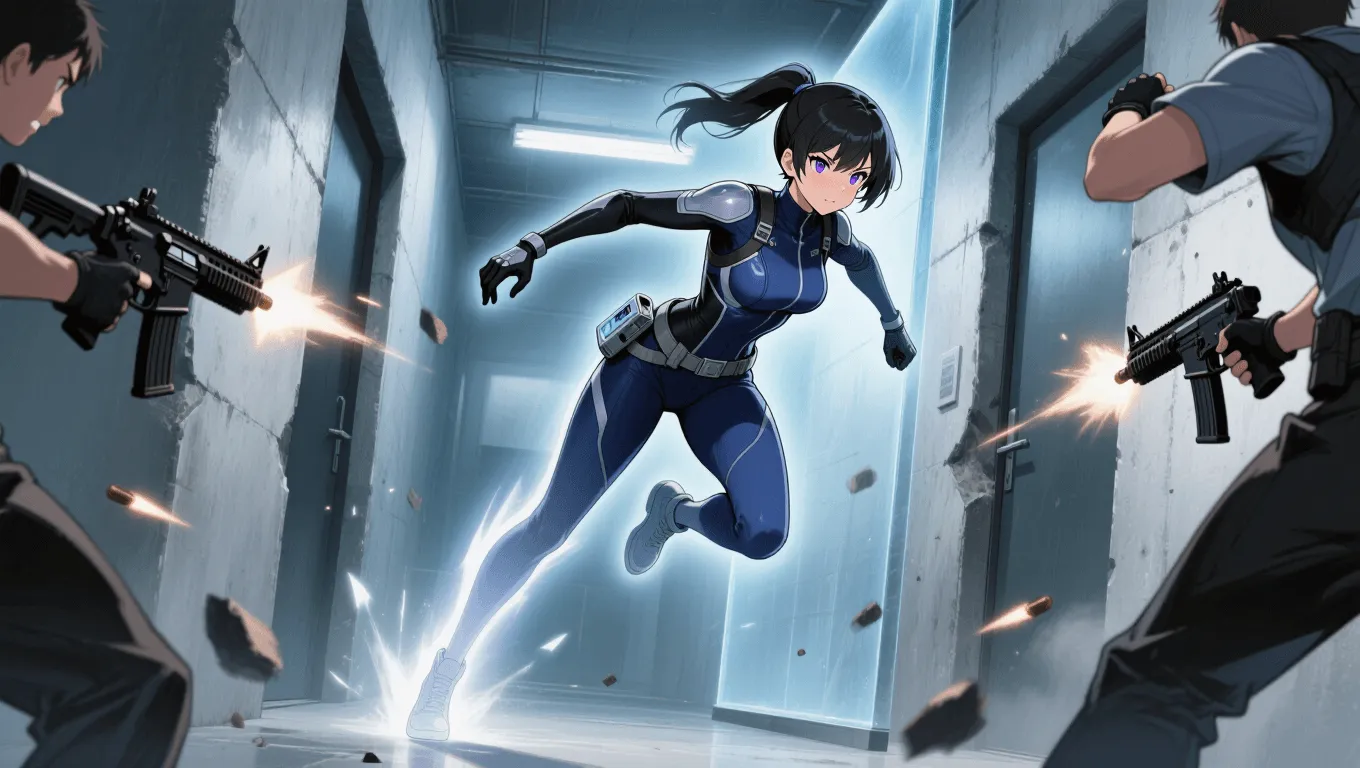
- Short bursts of intangibility to dodge strikes and projectiles.
- Simple wall pass-throughs (thin barriers, doors, standard interior walls).
- Limited timing window and strong focus requirements.
- Minimal “phase carry” (maybe small items, not other people).
In combat, Level 1 users are evasive skirmishers who survive by perfect timing—turning intangible just long enough to avoid hits, then returning solid to attack.
Level 2 🌇
At Level 2, control becomes versatile.

- Selective phasing of limbs and gear, enabling clean counters and safer rescues.
- Medium-to-thick material traversal (reinforced concrete, vehicles, layered walls).
- Phase carry for teammates or civilians for short distances.
- Better spatial awareness while inside/behind objects (often portrayed as a “phase sense”).
Level 2 users dominate enclosed spaces: corridors, stairwells, warehouses, and city blocks where cover is abundant and the opponent’s sightlines are limited.
Level 3 🌃
At Level 3, Phasing becomes a battlefield-shaping ability.

- Sustained intangibility with fine control over what remains solid.
- Complex traversal (multi-layer structures, underground routes, moving machinery).
- Confident phase carry (multiple people or heavy equipment, depending on setting).
- Offensive mastery: safe re-solidification windows, phase-based takedowns, and precision disarms.
At this tier, Phasing is less about “dodging hits” and more about rewriting the geometry of a fight—appearing where no one expects, extracting allies instantly, and neutralizing threats without trading blows.
Limitations of using the Phasing
Even in power-fantasy settings, Phasing needs constraints to stay interesting. Common limitations include:
- Concentration and timing: Staying intangible often requires focus; panic, pain, or sensory overload can disrupt control.
- Breathing and suffocation risk: Some portrayals require holding breath while inside solid matter, turning long traversals into a dangerous countdown.
- Sensory deprivation: Inside a wall, the user may not see or hear normally, increasing the chance of misjudging distance or emerging in the wrong place.
- The “stuck” problem: If Phasing ends while embedded in an object, stories typically impose consequences—pain, injury, forced ejection, or being trapped in an unstable state.
- Momentum rules: Some versions preserve speed and inertia, so a user who phases through a fall still hits the ground unless they phase through the ground too.
- Interaction tradeoff: While intangible, the user may be unable to strike, grab, or use equipment effectively—meaning Phasing is defensive unless they re-solidify at the right moment.
- Energy drain: Sustained phasing can tax stamina, making prolonged fights risky.
These constraints encourage skillful play: the strongest phasers aren’t the ones who stay intangible the longest, but the ones who switch states at exactly the right beat.
Weakness against what other superpowers
Phasing hard-counters many physical bruiser styles, but it has notable bad matchups depending on how a universe defines “intangibility.”
- Energy Projection: Heat, light, radiation, lightning, plasma, and wide-area energy bursts may still harm a phaser if the setting treats them as non-solid phenomena that can interact with an intangible target.
- Sonic Manipulation and Vibration Attacks: If a phaser’s intangibility relies on vibration frequency, an enemy who controls sound or resonance can disrupt the “phase pattern,” forcing solidity or causing painful feedback.
- Telepathy and Mind Control: Phasing protects the body, not necessarily the mind—mental attacks often bypass intangibility entirely.
- Gravity Manipulation: Gravity fields can pin, crush, or pull a phaser even if physical contact fails—especially if the power affects space around the target.
- Forcefields and Energy Barriers: Some barriers are explicitly designed to stop phase shifting by locking space, frequency, or dimensional overlap.
- Matter Manipulation: An opponent who can reshape the environment instantly (turn air to stone, grow crystal cages, warp material density) can create traps that punish mistimed re-solidification.
- Reality Warping and Time Stop: “Rules-breaking” powers commonly ignore conventional defenses, making Phasing unreliable as a universal answer.
In short: Phasing is strongest against touch-based threats, and weakest against field-based threats.
Synergistic Power Combos
Phasing becomes especially potent when paired with powers that solve its main drawbacks: limited offense while intangible, sensory problems, and stamina costs.
- Invisibility + Phasing: The ultimate infiltration kit—unseen and untouchable, ideal for extraction missions.
- Teleportation + Phasing: Teleport handles long-distance movement; Phasing handles short-range bypass and escape when teleport is blocked or risky.
- Enhanced Senses or Clairvoyance: Counters the “blind in the wall” issue, letting the user navigate safely before re-solidifying.
- Technopathy: A phaser can enter secured facilities physically, while technopathy handles the locks, cameras, and data once inside.
- Forcefield Generation: Use Phasing for movement and evasion, then deploy a barrier for moments when the user must remain solid to attack or protect allies.
- Healing Factor: Reduces the danger of partial failures—mis-timed solidity, embedded injuries, or harsh “ejection” effects.
- Shadow Manipulation or Darkness Control: Dark cover reduces the need for constant intangibility and makes reappearance points harder to predict.
For more combo ideas across a wider catalog, browsing the superpower list can help, or the random superpower generator can spark unexpected pairings.
Known Users
Phasing shows up across comics as a signature mobility-and-defense power.
- Kitty Pryde (Shadowcat) – A classic phasing specialist in Marvel, famous for slipping through matter and pushing the ability to extreme feats.
Outbound reference: Kitty Pryde on Marvel.com - Martian Manhunter (J’onn J’onzz) – DC’s powerhouse Martian who includes phasing among a broad suite of abilities.
- Vision – Often portrayed with density control that enables intangibility and “phasing through” solid matter.