
Plant Merging Superpower Guide

Plant Merging Video Demo 🎬
Table of Contents
Plant Merging is a nature-based superpower that allows a person to fuse their body with living plants for growth, concealment, movement, and defense. Instead of just controlling vegetation from afar, the user becomes one with it, creating a powerful form of plant fusion that blends biology, camouflage, and shapeshifting into a single ability. This makes Plant Merging a flexible choice for stealthy heroes, eco-themed villains, and mystical guardians of the wild.
For worldbuilders or RPG players exploring nature-themed abilities, Plant Merging fits neatly alongside other entries in a broader list of superpowers and works wonderfully with results from a random superpower generator when designing unique characters.
What Is Plant Merging?
Plant Merging is the ability to physically fuse with vegetation—trees, vines, flowers, roots, moss, and other plant life—either partially or completely. The user’s body can sink into bark, spread through roots, or dissolve into leaves, then re-emerge elsewhere or in a transformed state.
At its core, this power blurs the line between human and plant. A Plant Merging user may:
-
Meld with a tree to hide in plain sight
-
Grow bark-like armor or thorny spikes from their skin
-
Travel through dense undergrowth faster than normal walking
-
Regenerate wounds using nearby plant mass
Unlike simple plant control, Plant Merging is about bio-fusion: the user’s body and the plant’s structure become temporarily unified, sharing matter, energy, or senses. This leads to powerful defensive tricks, surprise attacks, and creative battlefield control.
Core Abilities of Plant Merging
Partial Fusion and Plant Armor
At a basic level, the user can merge parts of their body with plant material.
Common partial fusion effects include:
-
Bark armor: Thick, wooden plates form over the skin as natural body armor.
-
Thorn growth: Sharp thorns or spikes protrude from merged limbs for close combat.
-
Vine limbs: Arms or fingers elongate into flexible vines for grappling or disarming foes.
-
Root anchoring: Feet fuse with roots or soil-bound plants for enhanced stability and resistance to knockback.
This kind of plant-based shapeshifting is ideal for quick defensive responses and melee combat.
Full Assimilation and Movement Through Plants
More advanced Plant Merging allows complete assimilation into a plant or a network of plants.
A user might:
-
Step into a tree and vanish from sight
-
Travel through interconnected roots or vines and reappear from another plant
-
Spread their consciousness across a grove, using multiple trunks and branches as “bodies”
This creates a unique teleportation-like effect based on plant networks, especially in forests, jungles, or overgrown ruins.
Regeneration and Adaptation
When fused with a healthy plant, the user can tap into its life force:
-
Accelerated healing: Wounds close as the plant’s energy knits flesh and bark together.
-
Limb restoration: Severed limbs may regrow using surrounding plant biomass.
-
Environmental adaptation: The user’s merged form may become more drought-resistant, cold-tolerant, or toxin-resistant depending on the host plant.
This regenerative angle makes Plant Merging a strong survivability superpower in harsh environments.
Sensory Expansion and Botanical Awareness
Fusing with plants can also expand the user’s senses:
-
Wide-area detection through tremors in roots or pressure on leaves
-
Awareness of movement through underbrush or trees
-
Ability to sense disturbances in local plant life (burning, poisoning, cutting)
In some settings, this can feel like a “forest awareness” or eco-radar, making the Plant Merging user extremely hard to surprise.
Application / Tactical Advantages in Combat
Plant Merging shines when the battlefield contains vegetation, but even a small patch of plants can be enough for creative tactics.
Key tactical advantages include:
-
Stealth and ambush: The user can sink into trees, hedges, or flowerbeds, then emerge behind enemies for sneak attacks. In dense vegetation, they can effectively vanish.
-
Unpredictable positioning: By moving through plant networks, the user can relocate rapidly without exposing themselves to open fire. This is especially powerful in jungles or enchanted forests.
-
Environmental control: Fusing with thick roots or vines, they can help reshape terrain, block pathways, or create safe zones using living barriers.
-
Sustained endurance: Access to regenerative plant energy lets them stay in the fight longer, shrugging off wounds that would disable normal combatants.
-
Defensive forms: Bark plating, dense wooden shields, and root anchoring make them resistant to knockback, falls, and some physical projectiles.
In roleplaying or storytelling terms, a Plant Merging character dominates natural environments and turns seemingly harmless greenery into a web of hiding spots, escape routes, and ambush locations.
Level: Level 1 🏙️, Level 2 🌇, Level 3 🌃
Level 1 🏙️ – Budding Symbiosis
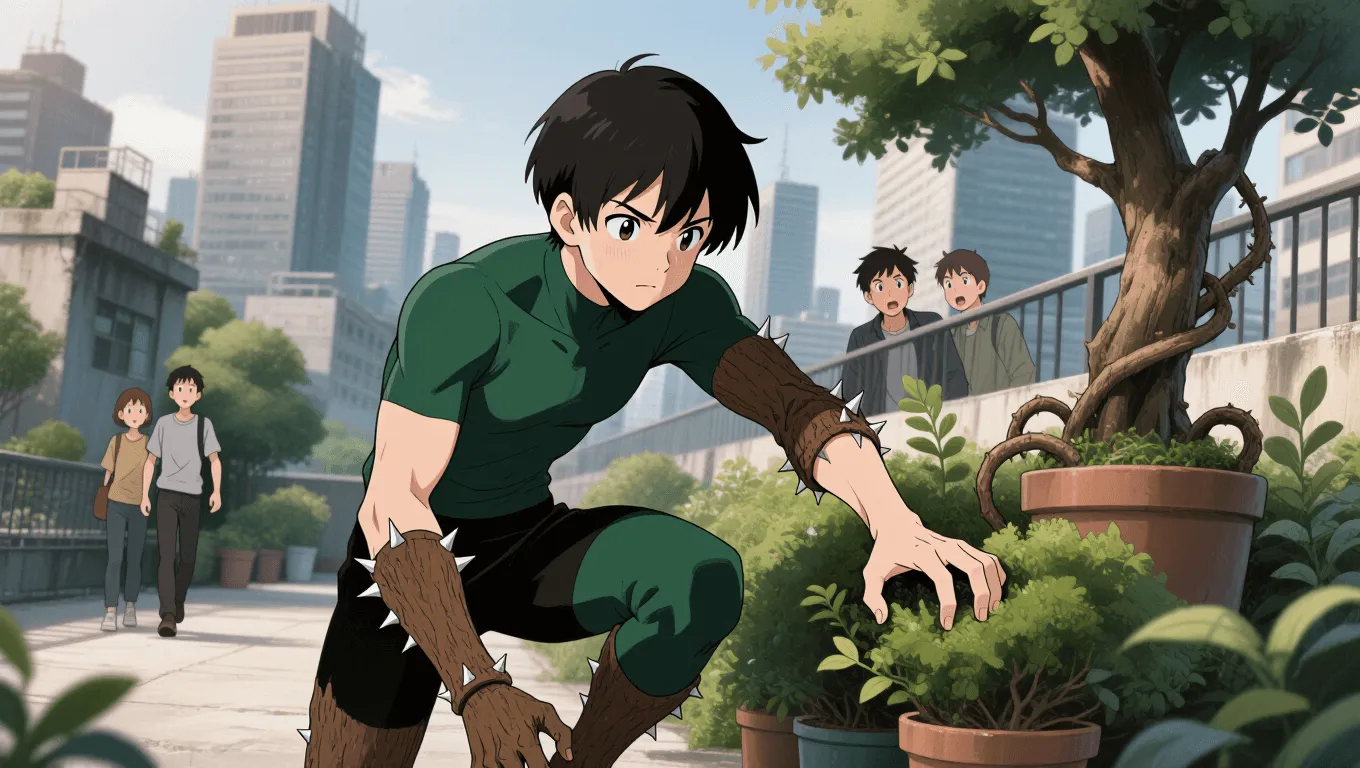
At Level 1, Plant Merging is limited but still useful:
-
User can fuse small areas of skin with nearby plants (hands, feet, arms).
-
Gains modest bark armor and minor thorn growth for scratching or deterrence.
-
Can hide partially inside bushes, flowerbeds, or small trees, but not fully vanish.
-
Healing is slightly faster than normal when in contact with plants, but not dramatic.
-
Movement through plants is minimal—perhaps slipping through a single trunk or emerging from the other side of the same plant.
In city settings with limited greenery, this level still helps with stealth and surprise maneuvers using park trees, rooftop gardens, or potted plants.
Level 2 🌇 – Deep Rooted Fusion

At Level 2, the power becomes a serious tactical asset:
-
Full-body fusion with mid-sized trees, thick vines, or heavy undergrowth.
-
Ability to move through connected root systems within a defined radius (e.g., a grove or park).
-
Bark armor is durable enough to resist low-caliber bullets or moderate blunt force.
-
Thorns and vine-limbs can be used as legitimate weapons—whips, restraints, or piercing attacks.
-
Regeneration is noticeable: cuts and bruises heal rapidly while merged; broken bones mend in hours instead of days.
This is the “elite operative in the forest” tier, where the user can ghost through wooded areas and turn ambushes into an art form.
Level 3 🌃 – Avatar of the Green

At Level 3, Plant Merging reaches its mythic potential:
-
The user can merge with entire groves, forests, or overgrown ruins, moving instantly between distant trees as long as a living plant connection exists.
-
Their body can dissolve into a swarm of leaves, petals, or climbing vines and reform at will.
-
Regeneration approaches near-immortality as long as sufficient plant life remains nearby to draw from.
-
Sensory awareness extends across wide regions of flora, making surprise attacks nearly impossible.
-
They can temporarily reshape their form into towering plant-giant hybrids or diffuse, intangible plant-spirits.
At this level, the user is less a person with a nature power and more a walking embodiment of the ecosystem.
Limitations of using Plant Merging
Despite its impressive scope, Plant Merging has clear weaknesses and boundaries:
-
Requires plant life: In barren deserts, deep space, or sterile metal corridors, the power is severely limited or even useless. No plants, no fusion.
-
Vulnerability of host plants: Damage to the plant while merged may harm the user. Burning or cutting the tree they hide in can injure or eject them.
-
Energy and stamina cost: Deep fusion, long-distance travel through roots, or large-scale regeneration can exhaust the user if overused.
-
Emotional or mental strain: Staying merged for too long might blur the user’s sense of self, leading to disorientation, apathy, or a growing preference for plant consciousness over human concerns.
-
Limited control over plant biology: Unless combined with plant manipulation or chlorokinesis, the user may not be able to drastically alter plant shapes beyond what their merging allows.
These limitations keep Plant Merging from being an all-purpose solution and encourage smart, context-aware use.
Weakness Against What Other Superpowers
Certain superpowers and power types are naturally effective against Plant Merging users:
-
Fire Manipulation: Flames can rapidly destroy host plants, burn bark armor, and sever root networks, forcing the user into exposed, non-merged states.
-
Ice or Frost Control: Freezing plants makes them brittle and less responsive, limiting the flexibility and protection of merged forms. Frozen wood shatters under stress.
-
Acid, Rot, or Disease Inducement: Powers that cause decay, fungal infection, or accelerated rot can corrupt the very medium the user depends on, turning safe refuges into hazardous zones.
-
Light or Heat Amplification: Intense, focused sunlight or heat can desiccate plants and dry out merged biomass, weakening the user’s structural integrity.
-
Metal and Tech-Based Powers: In heavily industrial or metallic environments, tech-based heroes can fight from outside the plant-dominated terrain, reducing the user’s mobility advantages.
-
Telepathy or Mind Manipulation: While merged, the user might be slightly distracted by expanded senses; a focused mental assault can exploit this divided attention.
Opponents who understand these weaknesses can deliberately burn, freeze, poison, or bypass plant life to neutralize this nature-bound superpower.
Synergistic Power Combos
Plant Merging becomes especially dangerous and versatile when paired with the right complementary superpowers:
-
Chlorokinesis / Plant Control: The most obvious combo. Controlling plant growth while being able to merge with it lets the user reshape battlefields in real time—growing new escape routes, traps, and armor.
-
Earth Manipulation: Controlling soil and stone around plant roots allows for massive terrain reshaping, burying enemies in root-choked earth or raising platforms of living wood and rock.
-
Water Manipulation: Plants rely on water. Moisture control can supercharge growth, reinforce merged forms, or flood areas with dense, water-rich vines that are hard to burn.
-
Healing or Life Energy Manipulation: Such powers can amplify plant vitality, making merged armor tougher, regeneration faster, and host plants nearly impossible to kill.
-
Invisibility or Shadow Stealth: Combining Plant Merging with stealth powers creates unmatched ambush specialists; they vanish into a tree, turn invisible, and reappear anywhere in the canopy.
-
Size Manipulation: Growing or shrinking while merged with plants can create towering tree-giants or tiny root-scouts for infiltration.
For character building, combining Plant Merging with other eco-based or support powers can yield powerful guardians, druids, or nature-themed bosses.
Known Users
While “Plant Merging” may go by different names in various universes, several well-known characters exhibit similar nature-fusion abilities:
-
Swamp Thing – A DC Comics character who can merge with and inhabit plant life across vast distances, effectively becoming an avatar of the Green.
-
Poison Ivy – Often depicted with a strong bond to plants, some versions show her partially fusing with vines or growing plant-like features as armor or weapons.
-
Groot – This Marvel character’s body is entirely plant-based, allowing him to regrow, reshape limbs, and integrate with plant matter in creative ways.
-
Forest-bound druids, dryads, or nature spirits in many RPGs and fantasy worlds commonly display a form of Plant Merging, stepping into trees or emerging from living groves as guardians of sacred forests.
In RPG campaigns, Plant Merging can define an entire archetype: a quiet wanderer who literally disappears into the woods, a terrifying eco-terrorist striking from parkland, or a mystical forest sentinel whose body and the wild are one and the same.