
Tachyon Mimicry

Tachyon Mimicry Video Demo 🎬
Table of Contents
What Is Tachyon Mimicry
Tachyon Mimicry is the ability to transform into tachyonic energy and move faster than light, effectively becoming a superluminal “tachyon form” rather than a normal biological body. In this state, the user behaves like a living burst of faster-than-light motion: crossing vast distances instantly, slipping past conventional defenses, and striking before opponents can fully process what happened. Because tachyons are a hypothetical faster-than-light concept in physics, Tachyon Mimicry is usually treated as high-end sci-fi or cosmic-tier power in storytelling, often brushing against time travel, causality, and reality-breaking speed feats.
For readers exploring related abilities, Tachyon Mimicry sits near speedster powers, energy transformation, and reality-adjacent movement tricks in a broader superpower wiki ecosystem, where many motion and energy abilities overlap in fun ways.
Core abilities of Tachyon Mimicry
At its heart, Tachyon Mimicry is not just “running fast.” It is a full conversion into tachyon-like energy with unique side effects that can make the user feel more like a phenomenon than a person.
-
Tachyonic transformation (energy body): The user can shift from a physical body into tachyonic energy, often appearing as a streak, flare, or rippling field. This can bypass many mundane limits like muscle fatigue or friction—depending on the setting.
-
Faster-than-light travel (FTL speed): The defining feature is superluminal movement: outracing light-based detection and arriving before most reactions can trigger.
-
Near-instant repositioning: In combat terms, Tachyon Mimicry can look like teleportation, even if it is “just” extreme speed. To observers, the user may vanish and reappear across the battlefield.
-
Tachyon perception window: Many versions include a “speed mind” effect—enhanced processing so the user can function while moving at absurd velocities. Without it, FTL movement would be unusable because decisions can’t keep up.
-
Relativistic and causality-adjacent effects: Tachyons are often linked to paradoxes because faster-than-light signaling can be interpreted as information traveling backward in time in some frames. Fiction uses this to justify time skips, pre-emptive dodges, or “I was already there” moments.
-
Counterintuitive energy-speed relationship: A common tachyon trope is that reducing a tachyon’s energy makes it go faster (the reverse of normal particles). Some interpretations lean into this for power interactions, like getting faster when “drained.”
Application / Tactical Advantages in Combat
Tachyon Mimicry excels at turning the battlefield into a place where distance and reaction time barely matter. Even before reaching full “cosmic” levels, it offers several unfair advantages.
-
First-strike dominance: The user can open a fight by disarming, relocating an enemy, or shattering key gear before opponents can form a plan.
-
Perfect spacing control: Range becomes optional. The user can be melee, mid-range, and long-range within a single heartbeat, forcing enemies to defend all angles.
-
Hit-and-fade pressure: Instead of trading blows, the user chips away—strike, vanish, reposition, repeat—until an opponent’s defenses crack.
-
Recon and interception: Tachyon Mimicry is ideal for scouting, message running, and intercepting projectiles or ambushes, since the user can cross environments faster than alarms can spread.
-
“Pseudo-teleport” misdirection: Enemies often waste attacks on afterimages or aim where the user used to be.
Level: Level 1 🏙️
At Level 1, Tachyon Mimicry presents as brief tachyonic bursts rather than sustained faster-than-light travel.

-
Short superluminal dashes that resemble blink steps
-
Extreme dodge capability against bullets and basic energy blasts
-
Quick entry/exit rescues: grab someone, move them behind cover, return
-
Tactical disruption: knocking weapons aside, cutting straps, flipping switches
Level: Level 2 🌇
At Level 2, the user can hold tachyon form longer and weaponize speed more deliberately.

-
Sustained battlefield dominance: repeated strikes without being pinned down
-
High-speed grappling and relocation: moving enemies into traps or away from allies
-
FTL traversal across a city or region in moments (setting-dependent)
-
“Reaction theft”: opponents start responding to the previous position, never the current one
Level: Level 3 🌃
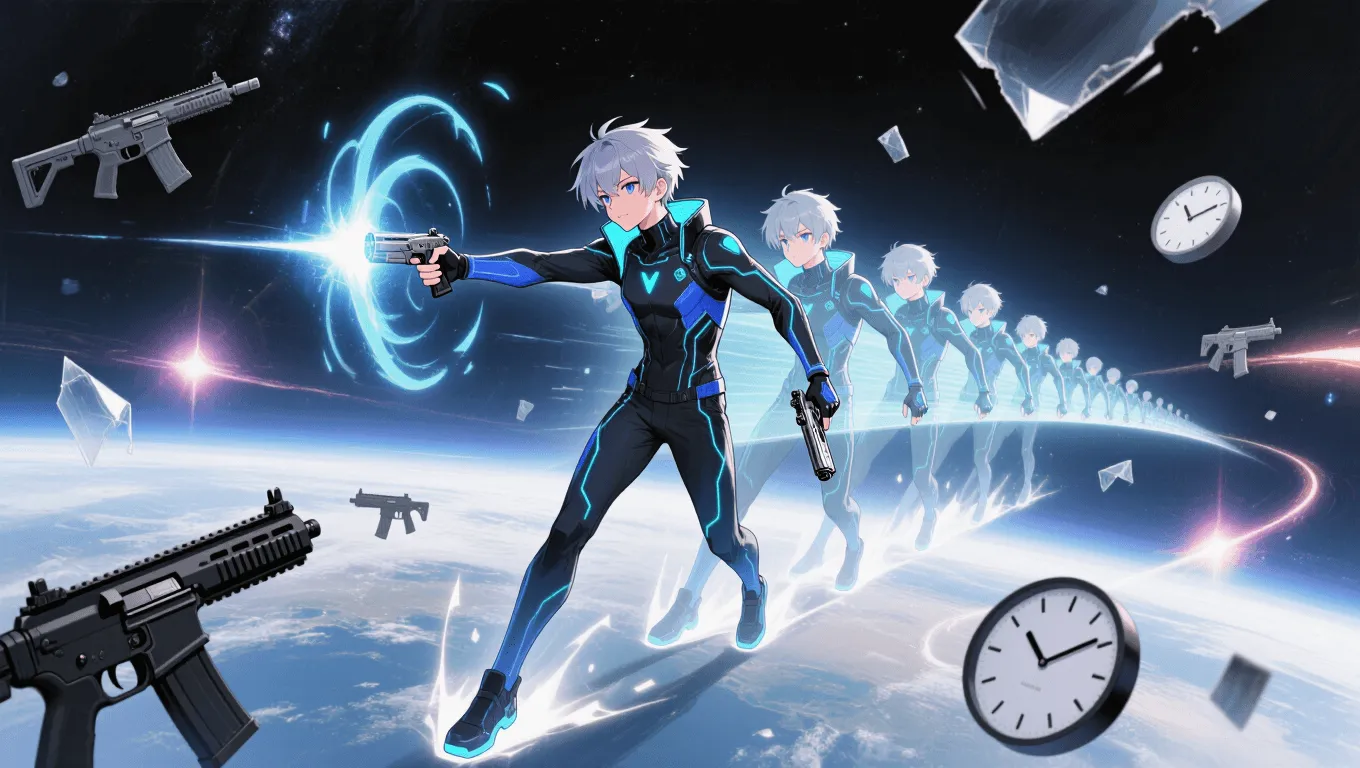
At Level 3, Tachyon Mimicry becomes reality-threatening speed.
-
Intercontinental or orbital-scale repositioning as a combat option
-
Superluminal feints that look like time tricks (arriving “before” an action completes)
-
Near-perfect interception of conventional attacks by removing the cause (disarming a shooter before the shot, etc.)
-
Possible timeline or causality side effects: paradox echoes, memory desync, or unstable time loops in the user’s wake
Limitations of using the Tachyon Mimicry
Even as a top-tier mobility power, Tachyon Mimicry is rarely “free.” Stories keep it balanced by attaching costs that scale with speed.
-
Control and navigation limits: Moving faster than light means tiny errors become massive. A misjudged angle can send the user into a wall, a mountain, or deep space—depending on how the setting treats inertia and momentum.
-
Perception bottleneck: If the user’s mind cannot process fast enough, FTL movement becomes reckless. Many versions require intense focus, training, or a specialized “tachyon sense” to avoid disasters.
-
Collateral risk: Extreme speed can generate shockwaves, ionization effects, or destructive wake turbulence unless the power includes a protective field. Some users must carefully avoid moving near allies or civilians.
-
Energy stability issues: Tachyon form may be harder to maintain when disrupted by certain fields (gravity wells, dimensional locks, time anchors), forcing the user back into a vulnerable physical state.
-
Causality strain: Because tachyons are often associated with paradox problems, writers frequently impose “timeline backlash” rules: the more the user abuses superluminal stunts, the more reality pushes back (lost time, temporal fatigue, glitches, or unwanted future echoes).
-
Limited offense without preparation: Pure speed does not automatically equal damage. If the user cannot safely deliver force (or carry weapons/energy shaping), they may struggle to hurt durable foes.
Weakness against what other superpowers
Tachyon Mimicry can outpace many threats, but it has natural counters—especially abilities that don’t rely on conventional reaction time.
-
Time Manipulation and Temporal Anchoring: If an opponent can freeze time, loop moments, or “lock” events in place, raw speed stops mattering. Temporal cages and time stop effects are classic answers to FTL movement.
-
Space Manipulation and Teleport Denial: Warping space, folding distance, or sealing areas can trap the user inside constrained geometry. If there is nowhere to “run,” speed loses value.
-
Gravity Manipulation: Strong gravitational fields can bend trajectories or pin the user’s energy form in place, especially if tachyon form is treated as field-like rather than purely kinetic.
-
Reality Warping and Order Manipulation: Any power that overrides the rules of motion can simply declare that superluminal movement fails, or that the user must re-materialize.
-
Wide-area attacks and omnidirectional hazards: A battlefield filled with persistent hazards (toxic fogs, omnidirectional lightning storms, layered minefields, psychic shockwaves) reduces the advantage of “being somewhere else,” because danger exists everywhere.
-
Precognition and probability control: If an opponent knows where the user will be, speed becomes predictable. The best counter to blitzing is removing surprise.
Synergistic Power Combos
Tachyon Mimicry becomes even more terrifying when paired with abilities that solve its biggest problems: control, offense, and counterplay.
-
Tachyon Mimicry + Enhanced Perception: A “speed mind” synergy—perfect for precision travel, mid-FTL course correction, and surgical combat.
-
Tachyon Mimicry + Phasing: Lets the user pass through matter while moving at impossible velocity, reducing collision risk and enabling stealth infiltrations.
-
Tachyon Mimicry + Electromagnetic Manipulation: Useful for creating a protective sheath, jamming sensors, or shaping a safe corridor through the environment.
-
Tachyon Mimicry + Psychic Shield: Protects the user from mental traps that don’t care how fast someone moves.
-
Tachyon Mimicry + Energy Conversion: Converts environmental energy into stabilization fuel, extending time spent in tachyon form.
-
Tachyon Mimicry + Illusion or Merging Vision: Turns superluminal movement into battlefield confusion—enemies cannot distinguish real position from bait.
-
Tachyon Mimicry + Creation: Enables pre-positioned tools, anchors, or “speed checkpoints” so the user can re-materialize safely and strike with prepared equipment.
For more combinations like these—especially if building a character kit—browsing a curated list on superpower wiki alongside a quick idea spin from the random superpower generator can help map out complementary strengths.
Known Users
Because Tachyon Mimicry is an extreme version of faster-than-light speed, it appears most often in cosmic, sci-fi, or “speedster pushed past the limit” character concepts.
-
Tachyon (Dr. Meredith Stinson) (Sentinel Comics universe): A super-speed hero strongly associated with cutting-edge science and comic-book speedster tropes.
-
Tachyon (Earth-691) (Marvel future setting): A character described as capable of faster-than-light movement and reactive energy redirection in reference databases.
-
Tachyon (robot member of Force): A character entry describing FTL travel and reflective, reactive capabilities in comics databases.