
Technopathy

Technopathy Video Demo 🎬
Table of Contents
What Is Technopathy
Technopathy is the ability to mentally interface with technology and influence how it behaves, from a single gadget to an entire network. In plain terms, a technopath can “talk to” machines, read what they’re doing, and push them to act differently—often without touching a keyboard, screen, or control panel. Many settings describe it as a psychic link to devices, letting the user communicate with, manipulate, or command technology using thought alone.
For readers exploring powers beyond technopathy, the broader catalog on the Superpower List is a handy jumping-off point, and the random superpower generator is a quick way to discover unexpected abilities for characters and worlds.
Core abilities of Technopathy
Technopathy usually breaks down into a few core skill clusters. Different characters emphasize different clusters, but the classic kit includes:
-
Machine communication: Sensing a device’s “state” (on/off, damaged, locked, connected), interpreting signals, and exchanging information with hardware and software.
-
Remote control: Issuing commands to electronics—opening doors, disabling alarms, piloting drones, stopping elevators, or rerouting traffic systems.
-
Digital intrusion without tools: Replacing conventional hacking steps (password attempts, phishing, brute force) with mind-driven access, like slipping past permissions by directly influencing the system.
-
Data perception and extraction: Pulling files, camera feeds, text logs, or sensor data into awareness, sometimes as images, sounds, or intuitive “knowing.”
-
Signal manipulation: Interfering with Wi-Fi, cellular, Bluetooth, radio, or satellite links—jamming, redirecting, or piggybacking on transmissions.
-
Device possession: Temporarily “inhabiting” a machine (a turret, robot body, or vehicle), treating it like an extension of the self.
-
Technoforming variants: Some versions include reshaping or reconfiguring tech components—turning scrap into functional devices, upgrading equipment on the fly, or merging systems into new builds (often framed as technokinesis or technoformation).
In many power taxonomies, technopathy overlaps with terms like cyberpathy, technokinesis, machine telepathy, and technology manipulation. Some lists describe technopathy specifically as mind-based interaction and command of technology, while broader “technology manipulation” may include creating or reshaping tech as well.
Application / Tactical Advantages in Combat
In combat, technopathy is dangerous because it turns the battlefield’s “stuff” into allies. Even in a simple room, there are lights, locks, cameras, phones, radios, vehicles, and security systems—each one a potential tool.
Common tactical advantages include:
-
Instant disarming: Modern fighters lean on smart scopes, powered armor components, comms, drones, and targeting aids. A technopath can sabotage these, forcing opponents back to raw skill.
-
Battlefield control: Locking doors, sealing shutters, triggering sprinklers, cutting lights, or rerouting elevators reshapes the terrain mid-fight.
-
Surveillance superiority: Cameras, microphones, motion sensors, and phone metadata can build a real-time map of enemy positions.
-
Drone swarms and turret flips: A technopath can hijack autonomous or remote-controlled weapons—turning a defender’s own security into an attacker.
-
Counter-ambush: Hidden mines, laser grids, and alarms can be detected or neutralized by “listening” to their signals.
-
Precision disruption: Instead of blowing up a generator, a technopath can trip breakers, corrupt firmware, or introduce tiny timing errors that cascade into failure.
-
Non-lethal shutdowns: Vehicles can be stalled, exosuits bricked, or stun settings triggered on enemy gear—ending fights without collateral damage.
Because so much modern combat depends on coordination, the silent advantage is communications dominance: cutting enemy comms while keeping allied comms intact can decide a battle before the first punch lands.
Power Levels of Technopathy
Level 1 🏙️
At Level 1, technopathy is close-range and device-focused.

-
Requires proximity (touch range to a few meters).
-
Works best on “simple” devices: locks, lights, basic cameras, consumer electronics.
-
Can perform quick actions: unlock/lock, power on/off, mute microphones, scramble a single feed.
-
Often feels like heightened intuition for how machines work, plus limited mental commands.
Combat impact: excellent for stealth entries, escapes, and disabling a single opponent’s gear, but not yet a full battlefield takeover.
Level 2 🌇
At Level 2, technopathy becomes network-aware and multi-target.

-
Can interface at longer ranges through signal pathways (Wi-Fi, cellular, wired networks).
-
Can juggle multiple devices at once: doors, cameras, drones, vehicles.
-
Can “read” system structure: users, permissions, connected nodes, vulnerabilities.
-
Can inject false data: fake camera loops, altered sensor readings, spoofed IDs.
Combat impact: can run a whole facility like a puppet stage—isolating enemies, feeding misinformation, and turning security systems into weapons.
Level 3 🌃
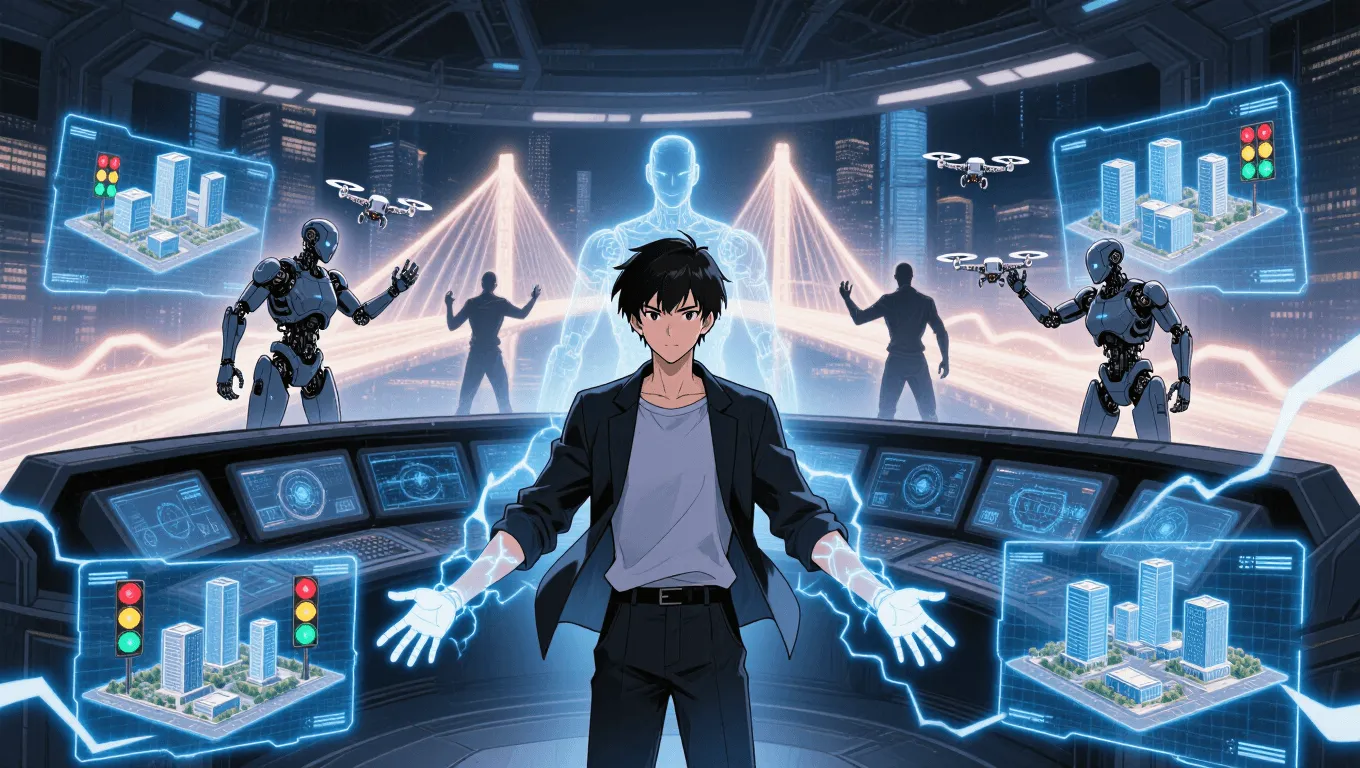
At Level 3, technopathy becomes systemic control, including advanced AI and complex infrastructure.
-
Can override hardened systems with layered security, adapting faster than conventional cyber defense.
-
Can coordinate city-scale tech: traffic grids, satellites, power routing, emergency alerts, drone fleets.
-
Can fight other technopaths in “signal space,” defending control of networks like a psychic tug-of-war.
-
May extend to technoforming-style feats in some settings, rebuilding or optimizing machines in real time.
Combat impact: the technopath becomes a one-person command center—capable of shutting down enemy logistics, commandeering autonomous weapons, and rewriting the battlefield at scale.
Limitations of using the Technopathy
Technopathy is powerful, but it is not effortless magic. Common limitations keep it fair and interesting:
-
Line-of-signal matters: Air-gapped devices, powered-down systems, shielded rooms, and isolated analog mechanisms are harder or impossible to control.
-
Complexity costs focus: A smart toaster is easy; a hardened military network with redundancy and active defenses can require sustained concentration.
-
Feedback and overload: Pulling too much data at once can cause sensory “noise,” headaches, confusion, or emotional bleed from constant alerts and signals.
-
Security countermeasures: Intrusion detection, encryption, fail-safes, biometric locks, and manual cutoffs can slow or block control—especially if the setting treats technopathy like a psychic form of hacking rather than an automatic win.
-
Range and interference: Distance, jamming, interference, underground structures, and Faraday-style shielding can reduce control reliability.
-
Device knowledge: Some interpretations require the technopath to understand what the device is and what it can do. Unknown alien tech or unfamiliar architectures may resist until “learned.”
A practical narrative limit is time-to-takeover: the technopath might be able to seize a phone instantly, but taking over a secured building during active combat could require a window of protection.
Weakness against what other superpowers
Technopathy’s biggest weakness is simple: it needs technology to matter. Powers that remove, distort, or bypass technology can neutralize its edge.
-
EMP Generation and electromagnetic disruption: Bursts that fry circuits or knock devices offline deny the technopath targets and pathways.
-
Magnetism Manipulation and Electromagnetic Manipulation: If a foe can bend metal and disrupt fields, they can physically damage or scramble the very systems the technopath relies on.
-
Reality Warping: When rules change, “systems” may stop behaving like systems, making control unpredictable.
-
Magic-based abilities: In settings where magic ignores physics, enchanted objects and spells can be immune to purely technological control.
-
Telepathy and Mind Disruption: If technopathy requires focus, psychic attacks that confuse, distract, or overwhelm can break the link mid-control.
-
Technology Nullification or Power Suppression: Abilities designed to cancel powers or disable technology directly are a hard counter.
In team fights, a classic counter-strategy is low-tech doctrine: analog radios, mechanical locks, paper maps, and manual weapon sights—boring, but effective.
Synergistic Power Combos
Technopathy becomes frightening when paired with powers that expand access, power supply, or survivability.
-
Electrokinesis (electricity control): Provides instant energy for charging, jump-starting systems, or forcing devices online long enough to seize them.
-
Energy Vision: Helps identify power sources, signal flows, and hidden devices—perfect scouting support for a technopath.
-
Invisibility or Shadow Manipulation: Enables silent infiltration while the technopath disables cameras, locks, and sensors.
-
Telepathy: Combines human intel with machine intel—reading minds for passwords while simultaneously overriding systems.
-
Gravity Manipulation: Locks down targets physically while technopathy locks them down digitally (vehicles stalled, doors sealed, drones grounded).
-
Replication or Duplication: Multiple bodies can maintain control across separate network zones, preventing a single disruption from breaking the takeover.
-
Healing Factor: Offsets the strain and feedback risks of high-load network control, letting the technopath “push harder” longer.
In stories, technopathy also pairs well with gadgeteers and inventors: the builder makes specialized hardware; the technopath makes it unstoppable in the field.
Known Users
Technopathy appears across comics and superhero media in different flavors—some characters interface as cyborgs, others as mutants, and others as pure psychics.
-
Cyborg (DC Comics): Frequently depicted as able to interface with computers and advanced technology as a core part of his cyborg nature.
-
Madison Jeffries (Marvel Comics): Commonly described with technopathic communication with AI and machines alongside technokinetic/technoform abilities, depending on portrayal.
-
Wiz Kid / Takeshi Matsuya (Marvel Comics): Often discussed in relation to technopathic-style control and advanced “technoforming” concepts, though some references frame his power more as technoformation than straightforward machine-telepathy.
These examples show how flexible the concept is: some settings treat technopathy as psychic hacking, while others treat it as a built-in interface that makes the user a living bridge between mind and machine.