
Ultraviolet Vision
Ultraviolet Vision Video Demo 🎬
Table of Contents
Ultraviolet Vision is the power to see ultraviolet light that normal human eyes can’t perceive. Instead of being limited to the usual visible colors, a user’s sight extends into the UV spectrum, revealing patterns, glows, and “invisible” signals that are otherwise hidden in plain sight. In practical terms, Ultraviolet Vision turns the world into a layered map of clues: security inks, fluorescent residue, sunlit UV reflections, and materials that absorb or scatter ultraviolet wavelengths differently than standard light. For readers exploring abilities across the Superpower Wiki, Ultraviolet Vision stands out as a deceptively tactical sense power that rewards observation and planning.
What Is Ultraviolet Vision
Ultraviolet radiation generally refers to electromagnetic wavelengths shorter than visible violet light, commonly described in the range of about 100–400 nanometers, with well-known bands like UVA, UVB, and UVC.
Ultraviolet Vision (often shortened to UV vision) grants perception of that ultraviolet range as usable visual information. Depending on the setting, this can work in different ways:
- Expanded-spectrum sight: the user sees normal colors plus additional UV “colors” or overlays.
- UV-only mode: the user can switch to a blacklight-like view that highlights fluorescence and UV reflectivity.
- UV sensitivity boost: the user detects near-UV (close to visible violet) most strongly, with diminishing clarity deeper into UV.
In storytelling terms, it functions like built-in UV detection without needing an external blacklight flashlight, allowing instant analysis of environments, objects, and living targets.
Core abilities of Ultraviolet Vision
Ultraviolet Vision isn’t about shooting beams; it’s about seeing what others miss. Core abilities typically include:
- UV spectrum perception: detecting UVA/UVB (and in rare high-tier cases, deeper UV ranges) as distinct visual cues.
- Fluorescence spotting: many substances fluoresce under UV, glowing visibly when stimulated by ultraviolet light. This can reveal residues, dyes, fibers, and treated markings.
- Hidden-ink detection: security inks on documents, currency markers, anti-counterfeit patterns, and coded notes can become readable.
- Trail and residue tracking: footprints in UV-reactive dust, smeared chemicals, detergent traces, and contact transfer become easier to follow.
- Material discrimination: different paints, plastics, fabrics, and coatings absorb or reflect UV differently, helping identify disguises, repairs, or swapped components.
- Biological surface tells: bruising patterns, certain skin conditions, or chemical contamination may show contrast changes (fiction often exaggerates this, but it’s a common Ultraviolet Vision trope).
A strong Ultraviolet Vision user also learns “UV literacy”: interpreting what UV glow means, distinguishing genuine fluorescence from reflective glare, and spotting intentional decoys.
Application / Tactical Advantages in Combat
In a fight, information decides outcomes. Ultraviolet Vision shines (sometimes literally) in messy, fast-moving situations where normal sight gets fooled.
Key combat advantages include:
- Anti-stealth sensing: stealth tech, camouflage paint, or smoke screens that look perfect in visible light may leak telltale UV reflections or absorption patterns.
- Trap detection: UV-reactive trip lines, pressure-plate markings, laser residue, or recent tool handling can be highlighted.
- Target identification: uniforms with UV markers, faction inks, or UV-reactive thread can reveal allies, enemies, and imposters.
- Tracking under pressure: a fleeing opponent becomes easier to follow if their path leaves UV-visible disturbances (scuffed surfaces, chemical traces, splashed liquid).
- Low-light edge with a UV source: if the user carries or can trigger a UV lamp/blacklight, they can create a “private illumination” that others can’t interpret well.
- Counterfeit gear spotting: fake badges, altered IDs, swapped vials, or tampered seals can stand out immediately.
Level: Level 1 🏙️, Level 2 🌇, Level 3🌃
Level 1 🏙️
At Level 1, Ultraviolet Vision is situational but valuable.
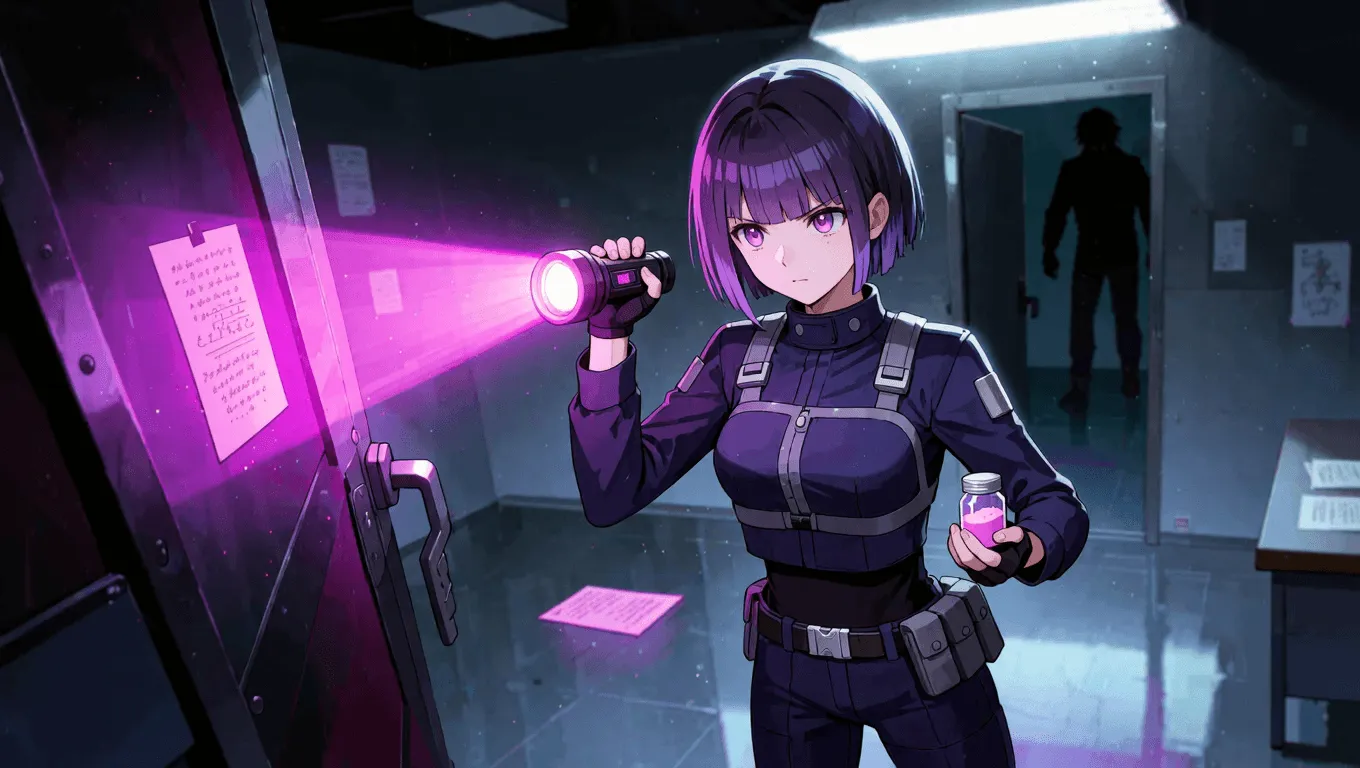
- The user can see near-UV cues, especially fluorescence under a UV lamp.
- They can detect obvious hidden inks, simple UV-reactive powders, and strong UV-reflective materials.
- Combat use focuses on quick checks: “Is this door trapped?” “Is that document authentic?” “Did someone pass through here recently?”
Downside: bright sunlight or chaotic lighting can overwhelm the user with confusing highlights, and their interpretation skills are still developing.
Level 2 🌇
At Level 2, the power becomes a consistent tactical sense.

- The user perceives UV overlays even without a dedicated blacklight, picking up UV signatures from sunlight and certain artificial sources.
- They can distinguish different UV-reactive compounds (not just “glow” vs “no glow”).
- They can track more subtle trails: faint smears, diluted chemicals, or partially cleaned evidence.
- In combat, they can “read” disguises and decoys faster, catching opponents who rely on visual misdirection.
This is the level where Ultraviolet Vision starts to feel like forensic vision in real time—less lab work, more live battlefield analysis.
Level 3 🌃
At Level 3, Ultraviolet Vision becomes elite reconnaissance.

- The user can filter UV input with precision, reducing noise and focusing on specific UV bands (UVA vs UVB-style effects, depending on the fiction).
- They can spot deliberate countermeasures, like UV-masking sprays or coatings, by noticing unnatural uniformity.
- They may detect UV-based signaling, coded patterns on moving targets, and advanced stealth materials engineered to fool normal observers.
- In team fights, they can act as a battlefield analyst—calling out traps, identifying the real target among doubles, and directing allies through safe paths.
At this tier, Ultraviolet Vision pairs naturally with leadership, infiltration, and counterintelligence roles.
Limitations of using the Ultraviolet Vision
Ultraviolet Vision is powerful, but it’s not all-seeing. Common limitations include:
- Signal dependency: if there’s little UV in the environment (or it’s blocked), the “extra layer” can weaken. Indoors with UV-poor lighting, it may become less useful unless the user has a UV source.
- Material blocking: many materials block or reduce UV transmission; for example, some glass and coatings significantly attenuate ultraviolet wavelengths, limiting what the user can perceive through barriers.
- Sensory overload: in strong sunlight, UV is abundant; a user might need training to prevent glare-like distraction from intense UV reflections.
- Interpretation skill: seeing a UV glow is easy; knowing what it means is harder. Cleaning chemicals, detergents, cosmetics, and industrial residues can create false positives.
- Range tradeoff: UV cues can be subtle at long distances, especially on matte surfaces or in dusty air.
- Countermeasures exist: UV-absorbing coatings, non-fluorescent materials, and deliberate UV-noise traps can mislead the user.
In many settings, responsible use also requires eye protection habits and disciplined toggling, because the user may choose to stare into UV-rich sources more often than a normal person would.
Weakness against what other superpowers
Ultraviolet Vision loses value when opponents control the conditions of perception or manipulate the electromagnetic environment. It tends to be weaker against:
- Darkness Manipulation: powers that swallow or dampen light can remove UV cues entirely, forcing the user back to standard senses.
- Light Manipulation and Photokinesis: an enemy who can flood an area with chaotic light (or specifically tuned UV) can create blinding noise and false trails.
- Illusion Casting: if illusions affect multiple senses or directly alter perception, Ultraviolet Vision may still be fooled unless it has a special “truth-seeing” property.
- Invisibility across spectra: true-spectrum invisibility that masks UV reflectance and fluorescence can neutralize this advantage.
- Electromagnetic Manipulation: a controller of radiation bands can jam UV perception, spoof UV signatures, or bend UV around objects to hide them.
- Reality Warping: any power that changes physical properties outright can erase the material “tells” Ultraviolet Vision relies on.
It’s also vulnerable to simple tactics: fighting in UV-poor environments, using UV-absorbing cloaks, or coating gear in non-reactive materials.
Synergistic Power Combos
Ultraviolet Vision becomes far stronger when paired with powers that supply light, expand analysis, or exploit discovered weaknesses.
- Infrared Vision: combining UV and IR creates a wider-spectrum tracking suite—UV for residues and markings, IR for heat trails and living targets.
- Night Vision: UV cues plus low-light clarity make nighttime infiltration and pursuit far easier.
- Enhanced Smell or Chemical Sensing: UV highlights where contamination is, and chemical senses confirm what it is.
- Electrokinesis or Light Generation: the user can produce controlled lighting (including blacklight-style illumination) to activate fluorescence on demand.
- Enhanced Wits: faster pattern recognition helps interpret complex UV scenes—distinguishing decoys from genuine clues and making rapid tactical calls.
- Stealth or Shadow Travel: Ultraviolet Vision helps choose paths that avoid UV-revealing surfaces, cameras, or security inks.
- Gadgeteering: pairing the power with UV-reactive powders, invisible inks, UV strobes, and anti-counterfeit scanners turns a user into a walking investigative toolkit.
In a larger roster built from the Superpower Wiki, Ultraviolet Vision often fills the “scout/analyst” niche—especially when discovered through a spin on a random superpower generator.
Known Users
Because Ultraviolet Vision is a specific sensory trait, it often appears as part of a broader “enhanced vision” package in comics and sci-fi. Notable examples include:
- Jet (DC Comics) — described as having electromagnetic abilities that include seeing in ultraviolet and infrared.
- Marvel characters associated with ultraviolet vision (category listings vary by continuity), often portrayed as having enhanced senses or specialized perception.
- Esperanza Garcia (Ultraviolet) in DC’s Arrowverse-related continuity is depicted with powers tied to ultraviolet energy and enhanced vision elements, depending on the source.