
Fire Mimicry: The Power of Becoming Living Flame
Fire Mimicry Video Demo 🎬
Table of Contents
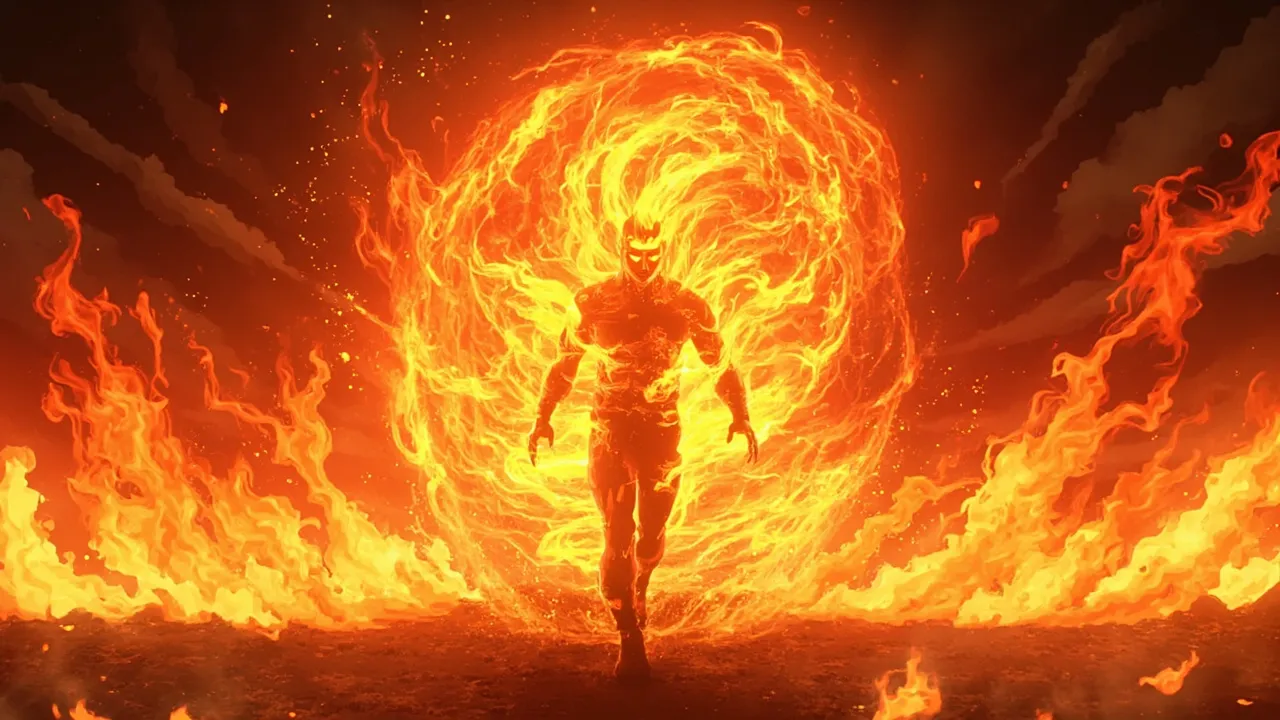
Fire Mimicry is a transformation-based superpower that allows a person to become living flame. Instead of merely controlling fire nearby, the user’s body shifts into a blazing fire form—often described as a flame body or fire elemental state—granting heat immunity, intense burning contact, and a terrifying presence on the battlefield. In this form, the user can ignite at will, radiate searing heat, and move like a flickering inferno that’s difficult to grab, restrain, or outmuscle.
For worlds filled with superhuman threats, Fire Mimicry is both simple and frightening: when the user turns into fire, everything close enough becomes fuel—if the user chooses to burn it.
What Is Fire Mimicry
Fire Mimicry is the ability to convert the user’s physical body into fire while retaining consciousness, movement, and intent. In most interpretations, the “body” becomes a coherent flame form rather than ordinary combustion. That means the user can still “stand,” “reach,” and “strike,” even though their anatomy is no longer flesh and bone.
This power sits at the crossroads of pyromorphing (becoming fire), elemental transformation, and thermal immunity. While it can resemble pyrokinesis on the surface, Fire Mimicry is fundamentally about embodiment: the user is the fire.
In a broader catalog of abilities—like those found on the superpower-wiki, Fire Mimicry is often classified as an elemental mimicry power with strong offensive utility and high environmental risk.
Core abilities of Fire Mimicry
Fire Mimicry typically expresses through a set of core traits. Exact rules depend on the setting, but these are the most common capabilities associated with becoming living flame:
-
Living flame transformation: The user switches between normal form and fire form, sometimes partially (hands, skin, aura) or fully (entire body).
-
Heat and flame immunity: The user resists or ignores heat damage, burning, and many forms of thermal shock while transformed.
-
Burning contact: Anything the user touches can be scorched, melted, or ignited, making grapples and melee defense extremely dangerous for opponents.
-
Flame projection: The user can expel fire from the body—bursts, jets, streams, or waves—often fueled by the user’s internal combustion energy.
-
Intangible-like behavior (situational): Some versions allow the user to slip through cracks, flow around obstacles, or disperse briefly like a plume, though not always true intangibility.
-
Self-illumination and smoke control (minor): The user can brighten or dim their glow, produce smoke, or reduce visible flame for stealth-adjacent play.
-
Regeneration through ignition (variant): Some users “re-form” from embers, reignite after impacts, or rebuild a flame body if dispersed.
Fire Mimicry also commonly includes secondary fire-adjacent effects: oxygen consumption, thermal distortion (shimmering air), and fear pressure—since few enemies remain calm while a person-shaped inferno advances.
Application / Tactical Advantages in Combat
Fire Mimicry shines in close- to mid-range fights, where positioning, panic, and area denial matter as much as raw damage.
Melee dominance without grappling. Many melee fighters rely on clinches, holds, and throws. Against a flame body, those options become self-harm. Even a brief grab can cause burns, weaken muscles, and force an immediate disengage.
Area denial and crowd control. Fire naturally shapes terrain: corridors become blocked, cover becomes unreliable, and enemies are pushed into predictable lanes. The user can “draw lines” of hazard to control movement.
Breaks common defenses. Shields, armor, and barriers often fail when heat rises long enough. Metal softens, plastics deform, and adhesives give way. Fire Mimicry can turn durability into a countdown.
Psychological warfare. Fire triggers primal fear. Even trained opponents may flinch, hesitate, or retreat from the instinctive threat of burning. That hesitation creates openings.
Sensor disruption. Heat haze distorts visuals. Smoke obscures line-of-sight. Infrared overload can blind heat-based detection. Fire Mimicry can interfere with both human perception and tech.
Mobility through flame bursts. Some users propel themselves with backdraft-like jets, leap with explosive ignition, or “slide” along surfaces as a flowing blaze. This makes vertical movement and rapid repositioning possible without conventional athletics.
For readers exploring powers across the wider system—especially via the random superpower generator, Fire Mimicry is often a standout because it offers offense, defense, and control in one visually dramatic package.
Level: Level 1 🏙️, Level 2 🌇, Level 3 🌃
Level 1 🏙️: Sparkform Initiate
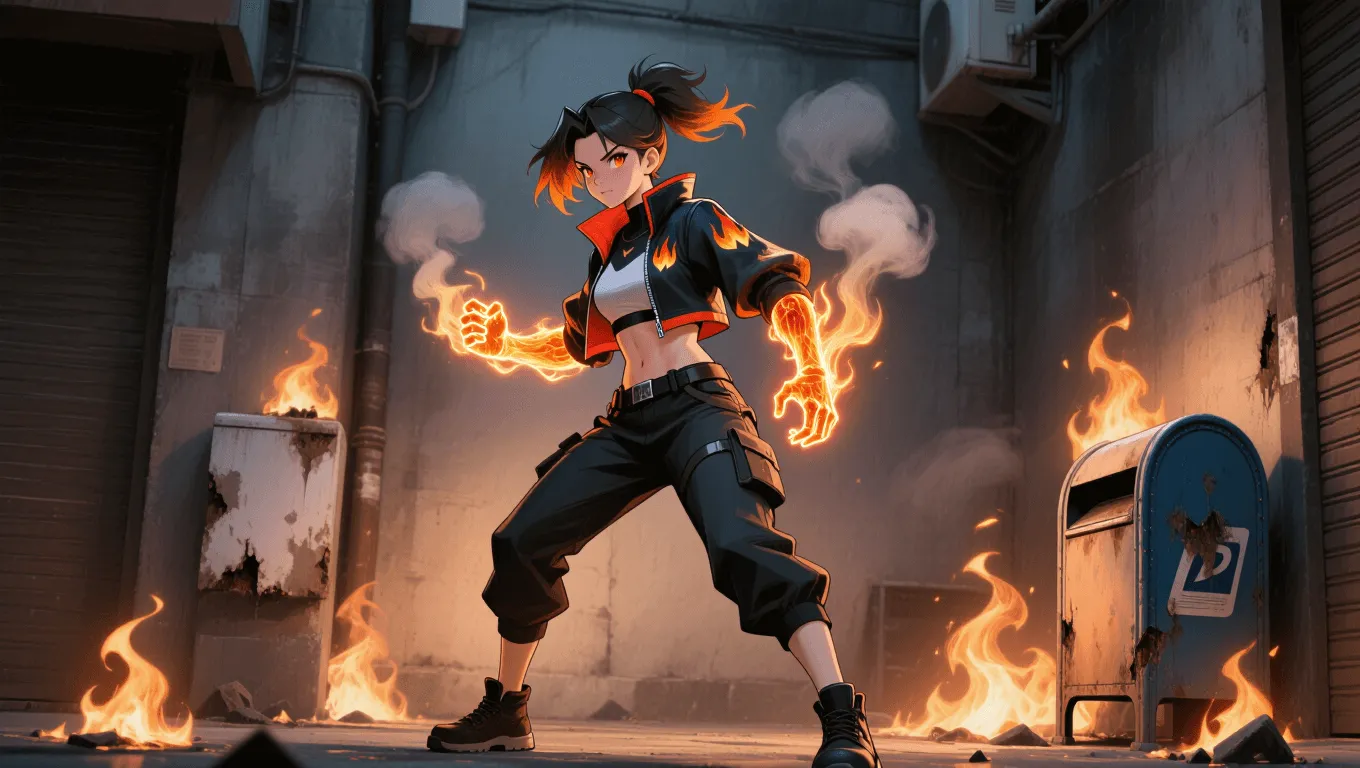
At Level 1, Fire Mimicry is powerful but constrained. The user can ignite reliably, but fine control and sustained output are limited.
-
Partial transformation (hands/arms/skin) or short-duration full flame form
-
Basic heat immunity (resists burns, hot surfaces, brief exposure)
-
Burning touch and small flame bursts
-
Light smoke generation and mild heat shimmer
-
Drawbacks: quick fatigue, difficulty modulating temperature, accidental ignition risk under stress
Combat style at this stage focuses on intimidation, short engagements, and creating openings rather than prolonged infernos.
Level 2 🌇: Blazebody Adept
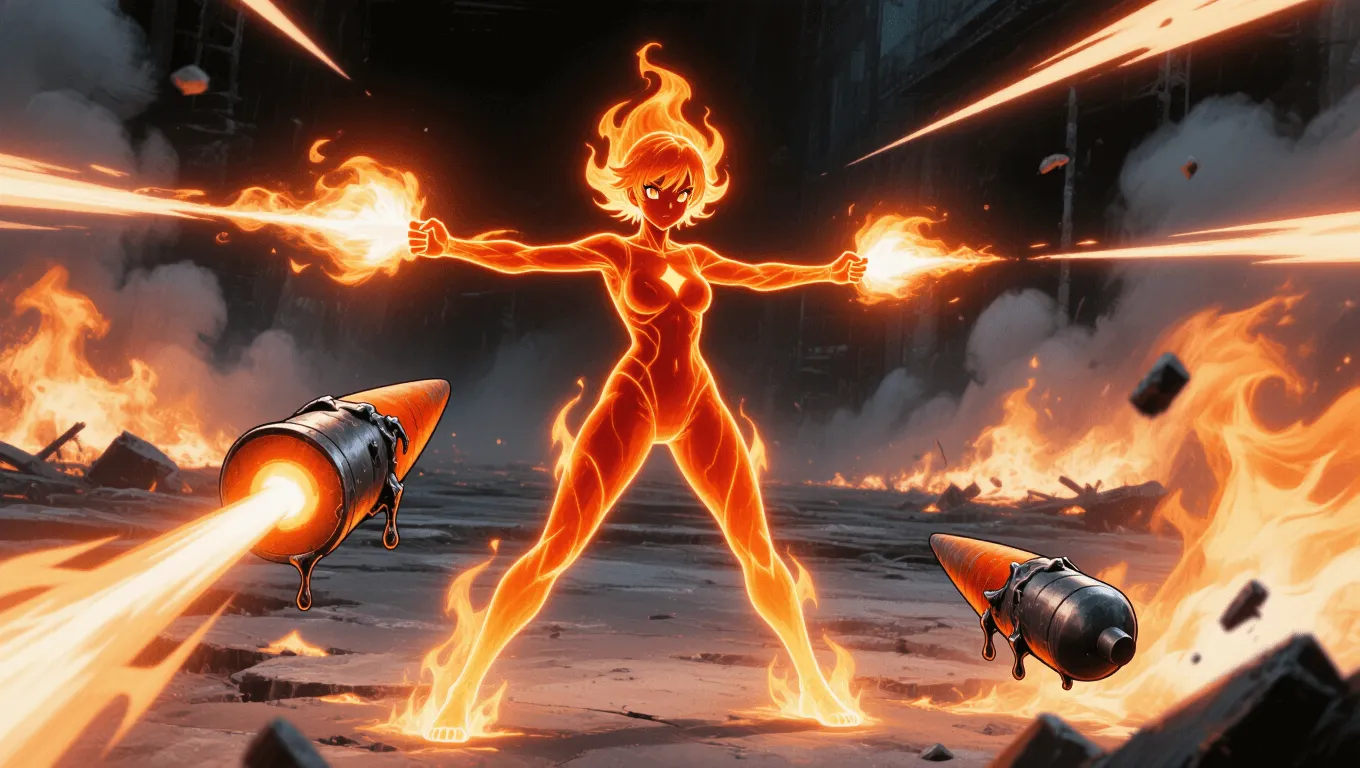
Level 2 is where Fire Mimicry becomes a true battlefield tool. The user can maintain a stable flame body and shape their output.
-
Full-body flame form with reliable cohesion and movement
-
High heat immunity (resists explosions, intense fire, extended exposure)
-
Directed flame jets, arcs, and cone blasts with improved accuracy
-
Terrain control: laying burning zones, scorching cover, forcing reposition
-
Controlled brightness and smoke for concealment and misdirection
-
Defensive reactions: flaring outward to repel attackers or melt projectiles that linger too long
At this level, the user starts thinking like a hazard engineer—turning the environment into a weapon.
Level 3 🌃: Inferno Elemental Master
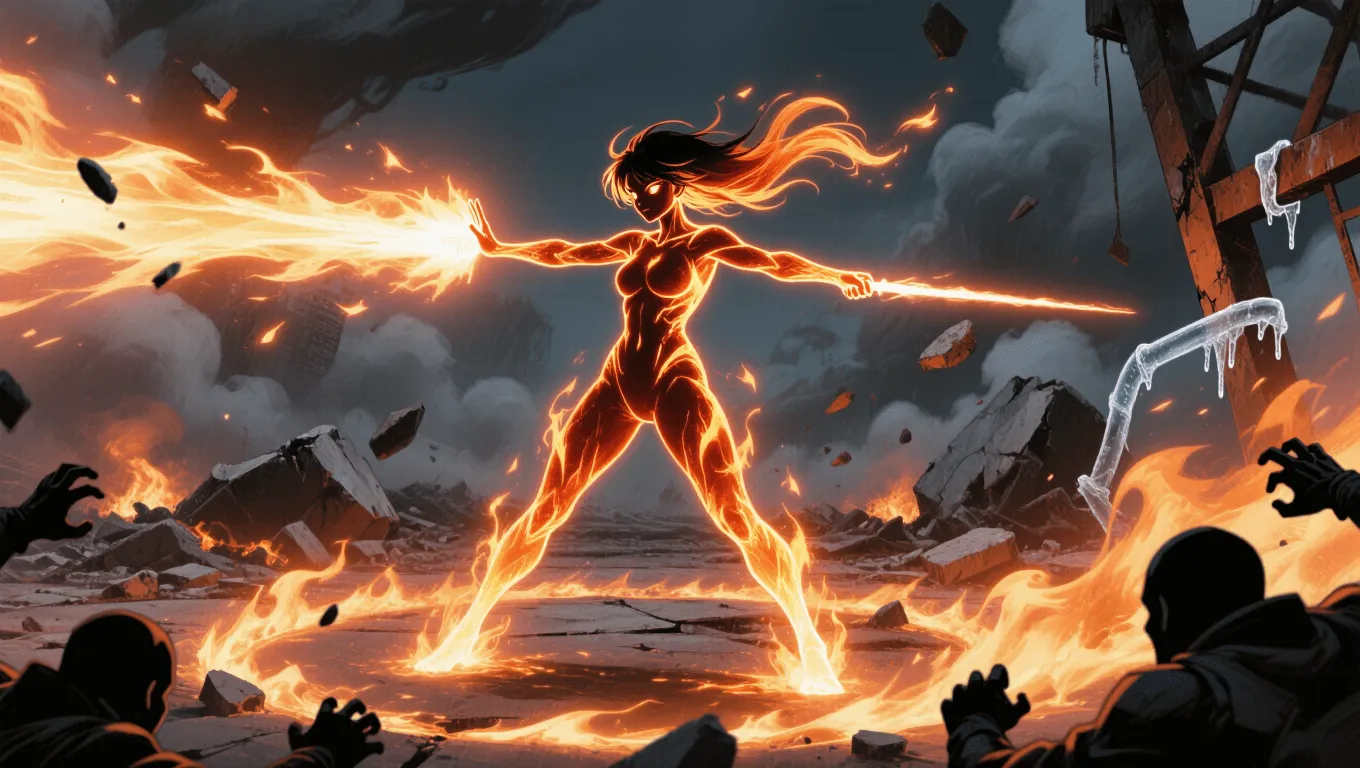
Level 3 pushes Fire Mimicry toward mythic “fire elemental” territory. The user’s flame form becomes strategic, scalable, and hard to counter without specialized powers.
-
Sustained, high-output inferno form with exceptional stability
-
Precision heat control: sear without igniting, weld metal, cauterize, or selectively burn targets
-
Advanced mobility: flame propulsion, explosive bursts, rapid vertical climbs, controlled dispersal and reformation
-
Wide-area denial: heat walls, ring fires, smoke screens, and “thermal corridors” that funnel enemies
-
Enhanced resistance: strong defense against cold shocks and thermal dampening attempts (depending on setting rules)
-
High-level drawback: collateral risk becomes extreme; the user must actively manage unintended damage
At the top tier, Fire Mimicry is less like “a person on fire” and more like “a moving disaster zone with intent.”
Limitations of using the Fire Mimicry
Despite its power, Fire Mimicry comes with real constraints that keep it from being an instant win button:
-
Fuel and oxygen dependence: Many versions require airflow. In vacuum, underwater, or sealed environments, output may weaken or become unstable.
-
Collateral damage: Fire spreads. Even when the user is careful, secondary ignitions can harm allies, civilians, and structures.
-
Control burden: Managing temperature, direction, and intensity can take focus. High emotion can cause flare-ups or loss of precision.
-
Visibility problems: A blazing form is bright, loud, and hard to hide. Stealth becomes difficult unless the user can dim flames or shift to ember-state.
-
Environmental counters: Rain, fire suppression foam, inert gas flooding, and heat-resistant materials can reduce effectiveness.
-
Friendly-fire risk: Close allies may be unable to approach, heal, restrain, or assist without protection.
-
Energy drain: Many settings treat flame generation as metabolically expensive. Long fights can cause exhaustion once the user returns to normal form.
These limitations are what turn Fire Mimicry into a skill power. The strongest users are not just hotter—they are smarter with ignition timing, angle control, and battlefield planning.
Weakness against what other superpowers
Fire Mimicry has clear matchups where it struggles, especially against powers that remove the fire’s prerequisites or convert its strengths into liabilities:
-
Water Manipulation and Hydrokinetic Control: Flooding, pressure jets, and forced submersion can smother flame output or disrupt cohesion.
-
Vacuum Creation or Air Removal: Fire needs oxygen in many interpretations. Removing air can “starve” the flame form.
-
Ice Manipulation and Extreme Cold Generation: Rapid cooling can destabilize the flame body, reduce output, or force reversion—especially if the user can be encased or flash-frozen.
-
Energy Absorption: If an opponent can absorb heat or thermal energy, Fire Mimicry can become a battery for the enemy.
-
Smoke and Gas Control: Thick particulates, inert gases, or chemical suppressants can choke combustion and hamper visibility.
-
Force Fields and Containment Barriers: Fire can be trapped. A sealed sphere or airtight cage can limit oxygen and prevent spread.
-
Telekinesis and Long-Range Precision: Fire Mimicry is terrifying up close, but careful standoff control can keep the user at distance and manipulate the environment to limit angles.
In balanced worlds, Fire Mimicry often dominates “brawlers” but risks hard counters from environmental controllers and containment specialists.
Synergistic Power Combos
Fire Mimicry becomes even more dangerous when paired with complementary abilities. Some of the strongest synergy combinations include:
-
Wind Manipulation: Wind can feed flames, spread heat, and sculpt fire into fast-moving sheets or spirals. It also helps clear smoke when visibility is needed.
-
Heat Vision or Thermal Detection: Seeing heat gradients helps the user target weak points in armor, locate enemies through smoke, and avoid overheating allies.
-
Teleportation: Short teleports plus flame form create brutal hit-and-fade strikes—ignite, appear close, scorch, vanish.
-
Density Control: Becoming lighter can allow flame-driven flight-like movement; becoming denser can anchor the user against knockback while maintaining a burning perimeter.
-
Smoke Generation: If separate from the flame form, deliberate smoke control can create stealth zones, decoy silhouettes, and ambush angles.
-
Psychic Shield: Fire Mimicry can be countered by calm, precise opponents; a mental defense helps the user keep control under stress and resist manipulation.
-
Regeneration: If the user can heal quickly in normal form, they can take bigger risks with energy drain, reverting briefly to recover between inferno bursts.
Synergy builds tend to focus on one of three themes: amplifying spread (wind), enhancing control (senses/psychic), or improving survivability (regeneration/defense).
Known Users
Because Fire Mimicry is a classic elemental transformation concept, it appears across comics and superhero media in characters who can fully ignite and function as a living blaze. A well-known example is Human Torch (Johnny Storm), whose “flame on” state closely resembles the core idea of a coherent flame body with heat immunity and fire projection.
Other fictional users and near-matches often include:
-
Fire-elemental beings that manifest as humanoid flame
-
Superhumans with full-body ignition forms rather than simple fire blasts
-
Mythic spirits or cursed champions whose bodies become living fire during combat
For more elemental and transformation abilities like this, browsing the Superpower Wiki can help compare Fire Mimicry to related powers such as Light Manipulation, Energy Conversion, and Phasing, while the random superpower generator is a quick way to discover unusual counters and combo partners.